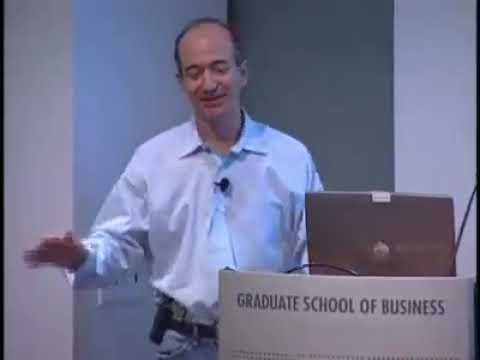
In a 2005 Stanford lecture, Jeff Bezos discusses Amazon's approach to innovation, emphasizing persistence, customer obsession, low-cost experimentation, and rejecting either-or thinking. He shares examples from history and Amazon's journey, highlighting the importance of incremental improvements, empowered teams, and focusing on what customers truly want: selection, low prices, and convenience.
In a compelling lecture delivered at Stanford in 2005, Jeff Bezos, the founder of Amazon.com, shares invaluable insights into how Amazon approaches innovation and customer service. Drawing from historical examples and Amazon's own journey, Bezos outlines principles that have driven Amazon's success and offers lessons for entrepreneurs and innovators everywhere.
Bezos begins by illustrating two ways innovation can occur:
Problem-Driven Innovation: Sometimes, innovation arises from frustration with an existing problem. For example, David Nelson Melany invented the whiffle ball in 1953 after his son broke a window with a regular baseball. Betty Nesmouth Graham invented Liquid Paper in 1956 because she was annoyed by the inability to erase mistakes on film cartridges used in typewriters.
Technology-Driven Innovation: Other times, innovation starts with a new technology or understanding, and innovators work backward to find a problem it can solve. Carbon dating is an example where understanding radioactive decay enabled a new solution.
Persistence is a critical ingredient for innovation. Bezos shares the story of WD-40, a product developed after 40 attempts to create a water displacement compound to protect Atlas missiles from rust. Although the missile market was small, the product found broader applications, and the company was eventually renamed WD-40 Company.
Bezos highlights "learned helplessness" as a major obstacle to invention. People often adapt to problems and stop noticing them. Great inventors are those who remain bothered by everyday annoyances and seek solutions. For instance, Mary Anderson invented the windshield wiper in 1913 because she found it ridiculous that drivers had to stop frequently to clean their windshields manually.
Similarly, Joseph Gayetty invented toilet paper in 1857, a product people didn't realize they needed until it was introduced.
Bezos humbly notes that Amazon's inventions may not be as groundbreaking as toilet paper but emphasizes the company's commitment to innovation over its nine and a half years of history.
The original Amazon website in 1995 was simple and lacked features like a search box on the homepage. Bezos personally wrote the HTML for it. Over the years, Amazon invested heavily in technology and content development, spending about $250 million in the previous year alone.
Amazon strives to reject either-or thinking, especially in customer service. For example, they aim to improve service quality while reducing customer contacts to save costs and offer lower prices. They achieve this by eliminating defects and enabling customer self-service, such as allowing customers to cancel orders or change shipping addresses online.
This approach has reduced customer contacts by 85% over seven to eight years.
Bezos stresses the importance of maximizing the rate of experimentation by lowering the cost of running experiments. High-cost experiments limit the number of tests and frustrate inventive employees. Amazon built infrastructure to allow small teams to run low-cost, self-service experiments without heavy institutional approval.
Examples include A/B testing different website features, such as adding countdown timers for delivery or images in product recommendations, to measure their impact on sales.
Amazon focuses obsessively on customers rather than competitors. Bezos argues that in fast-changing industries like online retail, competitor-focused strategies are less effective. Instead, focusing on what customers want—selection, low prices, and convenience—provides a stable foundation.
Amazon also offers free shipping with a minimum order amount for customers willing to wait longer.
Bezos shares an example of a feature called "instant order update" that reminds customers of previous purchases. Although it reduced short-term sales, Amazon kept it because customers loved it, believing it would build long-term loyalty.
Amazon uses technology to transform customer experience into a fixed cost rather than a variable cost, allowing them to serve millions of customers efficiently.
For example, they use sophisticated algorithms to optimize picking paths in massive fulfillment centers, improving productivity incrementally every day.
Bezos emphasizes hiring people who love to invent and build at all levels, from grand ideas to practical implementation. He shares his own early experience with computers in fourth grade, highlighting his passion for technology.
Bezos recounts the early days when Amazon was labeled "Amazon.toast" by analysts predicting its failure against giants like Barnes & Noble. Instead of being distracted, Bezos encouraged employees to focus on customers and not competitors or media narratives.
He advises entrepreneurs to maintain a balance of stubbornness and flexibility, knowing when to stick to their vision and when to adapt.
Bezos discusses Moore's Law and the rapid decrease in disk space costs, which enabled innovations like searchable full images of over 200,000 books.
He also highlights the launch of A9 Yellow Pages, a service with 20 million photos of over a million businesses across multiple cities, showcasing innovative use of technology and data.
Jeff Bezos's lecture offers a masterclass in innovation, persistence, customer obsession, and strategic focus. His insights reveal that successful innovation requires a blend of problem-solving, experimentation, and unwavering dedication to customer needs. Amazon's journey from a simple website to a technology powerhouse exemplifies these principles in action, providing valuable lessons for entrepreneurs and businesses aiming to innovate and grow in a rapidly changing world.