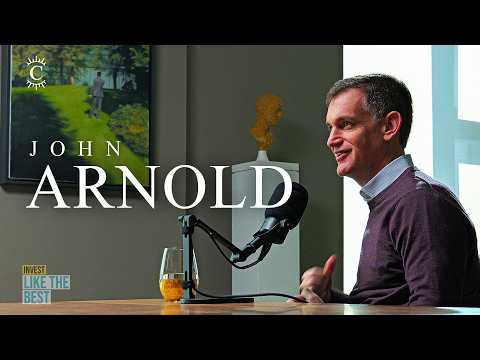
John Arnold, renowned energy trader and innovative philanthropist, discusses his experiences in energy markets, insights from his trip to China focusing on robotics and AI, and his views on the future of energy, infrastructure, criminal justice, education, healthcare, and journalism. He emphasizes the importance of building the best 'seat' in any industry and the challenges and opportunities in US energy and infrastructure systems.
John Arnold, widely regarded as the most successful energy trader of all time, shares his unique perspectives on energy markets, his observations from a recent trip to China, and his innovative approach to philanthropy. This comprehensive discussion covers a wide range of topics including the energy industry, technological innovation, US infrastructure, criminal justice reform, education, healthcare, and journalism.
John Arnold emphasizes the importance of cultivating the best "seat" in one's industry. This seat is characterized by having the best perspective, access to the most information, and the best systems. For Arnold, this approach was fundamental to his success in energy trading. After his trading career, he applied this concept to philanthropy, focusing on systemic problems across various sectors.
Arnold's trip to China revealed the country's remarkable transformation over the past 30 years, moving from replicating Western models to leapfrogging them. Key takeaways include:
Arnold visited several companies, including Neo, an upscale electric vehicle manufacturer. Their factory was built and operational within 17 months, featuring advanced automation and robotics surpassing many US plants.
Arnold notes a significant reduction in exchanges between the US and China since 2019, including fewer flights, expats, and students. China has domesticated many Western business practices and now positions itself as a global leader, no longer reliant on Western expertise. This shift presents challenges and opportunities for Western countries in defining a symbiotic relationship with China.
Arnold reflects on his trading career, highlighting:
Arnold primarily traded natural gas futures and swaps, focusing on the fixed price of natural gas at Henry Hub. As a market maker, he provided liquidity, gained insights into market psychology, and managed risk effectively.
Arnold discusses the energy sector's innovation, especially in assets like batteries, geothermal, and advanced nuclear. He outlines the goals of the US energy system:
He highlights the challenges posed by changing political priorities, slow infrastructure development, and the rapid growth of data centers demanding energy.
Arnold stresses that policy and permitting are critical factors affecting the US's ability to meet energy demand, contrasting with China's ability to build rapidly without such constraints.
Transmission lines are vital but difficult to build due to regulatory and community opposition. Arnold started a company to build interregional transmission lines, aiming to reduce costs, increase reliability, and lower emissions.
Arnold sees nuclear as promising but challenging. Traditional plants like the AP-1000 are costly and labor-intensive. Advanced nuclear and fusion hold potential but face uncertain economics and long timelines, likely 10-15 years away from significant deployment.
Arnold believes public-private partnerships are essential for funding long-duration energy technologies like advanced nuclear. He notes the crowded field of small modular reactors (SMRs) and the need for industry consolidation. Solar and battery technologies show promising cost curves but face challenges related to labor, permitting, and input costs.
Housing affordability and nimbyism ("not in my backyard") are significant challenges. Arnold notes bipartisan efforts to ease housing construction but warns that decades of regulations make quick solutions difficult. Subsidies may offer short-term relief but can worsen long-term problems.
Arnold's foundation focuses on long-term systemic solutions rather than short-term charity. He believes foundations should get less powerful over time as organizations tend to become bureaucratic and risk-averse. The foundation acts as a conduit between researchers and policymakers to experiment and evaluate what works in systems like healthcare, criminal justice, and education.
The foundation supports efforts like the Innocence Project to overturn wrongful convictions and improve the justice system. Arnold highlights the importance of focusing on the probability of getting caught rather than just penalties. He discusses reforms in pre-trial detention, cash bail, and balancing public safety with social justice and racial equity.
Arnold acknowledges the strong correlation between better K-12 education and improved societal outcomes. While optimistic about AI and edtech, he remains cautious due to decades of underwhelming results despite increased technology adoption. Engagement and delivery methods remain critical challenges.
The US healthcare system suffers from market failures, financialization, and complex regulations. Arnold describes a cat-and-mouse game between regulators and private industry, with examples like pricing strategies for new medical products. He advocates for tailored regulation depending on the system and stresses the need for alignment of incentives.
Arnold views journalism as a vital public good that checks government and private actors. With the decline of traditional newspapers, investigative journalism and local coverage are underfunded. He believes philanthropy should support journalism similarly to how it supports arts and culture.
Arnold remains hopeful about innovation's role in overcoming challenges. He shares a personal story about his brother's courageous honesty, which helped him reflect and improve his life beyond trading.
John Arnold's insights provide a rare and valuable perspective on complex systems, emphasizing the importance of passion, systemic thinking, and innovation in addressing today's most pressing challenges.