
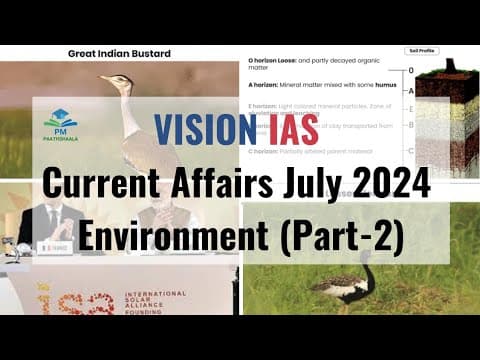
This blog post covers key environmental topics discussed in the July 2024 Current Affairs session by Vision IAS, including the International Solar Alliance, the Great Indian Bustard recovery program, soil health initiatives, and recent global environmental reports.
In this blog post, we will explore the significant environmental topics discussed in the July 2024 Current Affairs session by Vision IAS. The session highlights various initiatives, challenges, and developments in the environmental sector, focusing on global cooperation and local conservation efforts.
The International Solar Alliance (ISA) has recently welcomed Paraguay as its 100th member country. This milestone reflects the growing global commitment to solar energy as a sustainable solution to combat climate change. The ISA aims to promote solar energy technologies and facilitate investments in solar projects worldwide.
The current trajectory towards sustainable development is misaligned with the targets set by the Paris Agreement. Projections indicate that global emissions need to be reduced by 43% within this decade to meet the goal of limiting global warming to 1.5 degrees Celsius. To achieve this, an investment of between $1.6 to $2 trillion in solar energy is essential.
Solar energy is recognized as a versatile and accessible renewable energy source with the highest potential at lower costs. It offers a lower carbon footprint compared to other renewable sources like hydro and bioenergy. The decentralization potential of solar energy allows for off-grid systems, making it a viable option for remote areas.
The Ministry of Environment, Forest and Climate Change has approved a fund for the Great Indian Bustard recovery program for the period 2024-2029. This initiative aims to conserve the critically endangered Great Indian Bustard and the Lesser Florican, both of which face significant threats from habitat loss and human activities.
The recovery program focuses on securing the population of these species, conducting applied research, and enhancing habitat management. The project is part of the National Bustard Recovery Plan initiated in 2013, which has seen limited success due to various challenges, including land acquisition and ecological harm.
Soil health is crucial for maintaining biodiversity and ensuring sustainable agriculture. An international conference in Morocco led to a commitment by UNESCO to support member states in developing a World Soil Health Index. This initiative aims to assess soil quality and degradation trends globally.
Soil degradation affects approximately 3.2 billion people worldwide, with projections indicating that by 2050, 90% of soils could be degraded. Factors contributing to soil degradation include deforestation, erosion, and improper agricultural practices.
To improve soil health, promoting organic farming, implementing soil health cards, and enhancing forest cover are essential strategies. These measures will help restore degraded lands and improve agricultural productivity.
Several significant reports have been released recently, highlighting the state of the environment:
The July 2024 Current Affairs session by Vision IAS sheds light on critical environmental issues and initiatives aimed at fostering sustainable development. From the International Solar Alliance's expansion to the recovery of endangered species and the importance of soil health, these topics underscore the need for global cooperation and local action in addressing environmental challenges. As we move forward, it is essential to remain informed and engaged in these vital discussions to ensure a sustainable future for our planet.



















