
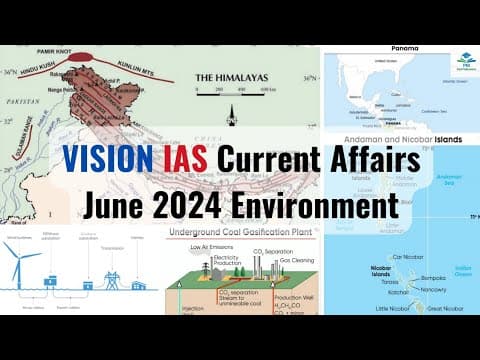
This blog post covers the key environmental topics discussed in the June 2024 edition of Vision IAS Current Affairs, including the impact of climate change on Small Island Developing States, the Indian Himalayan Region, and the Great Nicobar Islands, along with recent initiatives and challenges in environmental management.
In this blog post, we will explore the significant environmental topics highlighted in the June 2024 edition of Vision IAS Current Affairs. This edition covers various pressing issues, including the impact of climate change on Small Island Developing States (SIDS), the Indian Himalayan Region (IHR), and the Great Nicobar Islands, along with recent initiatives and challenges in environmental management.
The first topic we will discuss is the challenges faced by Small Island Developing States (SIDS) due to climate change. Panama has emerged as a pioneer by relocating communities from dangerous areas affected by rising sea levels. Approximately 300 families have been relocated from the Gardi Sukhda Island to the mainland due to the severe impacts of climate change.
The Coalition for Disaster Resilient Infrastructure (CDRI) has allocated $8 billion for infrastructure development in SIDS to enhance their resilience against disasters. This initiative was announced during the United Nations' Fourth International Conference on Disaster Risk Reduction. The IRIS program, which includes members from Australia, the European Union, and India, aims to promote sustainable development through impactful partnerships.
SIDS share common characteristics, including vulnerability to environmental challenges, economic instability, and social issues. Notable examples of SIDS include the Maldives, Marshall Islands, and Solomon Islands, which are primarily located in the Caribbean, Pacific, and Indian Oceans. These regions are recognized for their unique challenges, particularly in the context of climate change.
The Indian Himalayan Region has gained attention due to a recent Supreme Court judgment that recognized the fundamental right to be free from climate change impacts. This judgment emphasizes the need for sustainable development in the region, which spans 2,500 kilometers across 13 states and union territories in India.
The IHR is crucial for water resources, biodiversity, and climate regulation. It serves as a water tower for 1.4 billion people, feeding major rivers like the Ganga and Yamuna. However, the region faces significant challenges, including unsustainable development, deforestation, and the impacts of climate change.
The IHR is experiencing severe environmental degradation due to deforestation, mining, and tourism. To address these issues, the government has initiated several programs, including the National Mission for Sustainable Himalayan Ecosystem and the Indian Himalayan Climate Adaptation Program, aimed at promoting sustainable management and development in the region.
The Great Nicobar Islands are in the spotlight due to the proposed Greenfield International Airport project. The project aims to enhance connectivity and promote sustainable tourism in the region, which is part of the Andaman and Nicobar Islands.
While the project promises economic benefits, it raises concerns about habitat loss and the impact on local tribes. The government is conducting social impact assessments to evaluate the potential effects of the airport on the environment and local communities.
The Ministry of Coal has initiated a project for Underground Coal Gasification in Jharkhand's Jamtara district. UCG is a process that converts coal into gas, which can be used for electricity generation and as a feedstock for chemical production.
UCG offers several benefits, including access to unmined coal reserves and reduced environmental impact compared to traditional coal mining. However, challenges such as subsidence and technological limitations remain.
The government has introduced a viability gap funding scheme to support offshore wind energy projects. This initiative aims to harness India's extensive coastal resources for renewable energy generation.
India has significant potential for offshore wind energy, with a coastline of 7,600 kilometers. The government aims to install gigawatt-scale offshore wind projects in states like Gujarat and Tamil Nadu.
Two new Ramsar sites, Nagri and Nakti Bird Sanctuaries, have been designated in Bihar, highlighting the importance of wetland conservation.
The recent climate change conference emphasized the need for adaptation strategies and collective action to address global warming and its impacts.
The GEF has approved funding for various projects aimed at biodiversity conservation and sustainable development in least developed countries.
The UNDP has launched a Collective Intelligence Initiative to mobilize information and ideas to tackle climate change and poverty through technology and community engagement.
The June 2024 edition of Vision IAS Current Affairs provides valuable insights into the pressing environmental issues facing our planet. From the challenges of climate change impacting Small Island Developing States to the initiatives aimed at sustainable development in the Indian Himalayan Region and the Great Nicobar Islands, it is clear that collective action and innovative solutions are essential for a sustainable future. As we move forward, it is crucial to prioritize environmental conservation and resilience in our policies and practices.



















