
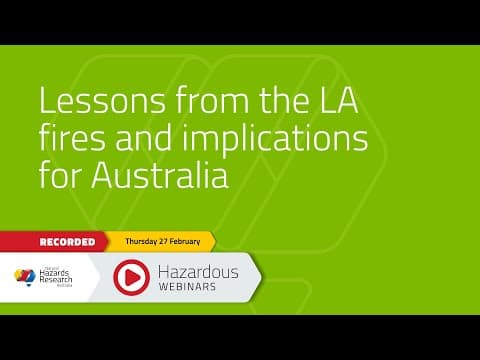
The recent LA fires serve as a critical case study for Australia, highlighting the need for improved urban planning, community engagement, and disaster preparedness to mitigate wildfire risks in the face of climate change.
In February 2025, a hazardous webinar was held to discuss the devastating wildfires in Los Angeles and their implications for Australia. The event was organized by Natural Hazards Research Australia in partnership with the Australian Academy of Science. The webinar featured a panel of experts who shared insights on the causes of the LA fires, the lessons learned, and how Australia can better prepare for similar disasters.
Andrew Gissing, CEO of Natural Hazards Research Australia, opened the session with an acknowledgment of the traditional custodians of the land, paying respects to First Nations people and their elders.
The LA fires resulted in significant destruction, with at least 20 fatalities, over 16,000 structures destroyed, and economic damages estimated between $150 billion and $275 billion USD. The fires highlighted the increasing risk of wildfires in urban areas, particularly in regions prone to extreme weather conditions.
Kelly Martin, a veteran firefighter with over 40 years of experience, shared her firsthand observations from the LA fires. She emphasized the importance of community preparedness and the need for better fire management practices. Kelly noted that many homes were built without considering fire risks, leading to devastating losses. She highlighted the emotional toll of witnessing entire neighborhoods vanish in a matter of hours.
Professor David Bowman from the University of Tasmania discussed the broader implications of the LA fires in the context of global climate change. He stressed that the fires are a culmination of signals indicating that wildfire activity is increasing due to climate change. David warned against merely bouncing back to previous practices and emphasized the need for transformative thinking and community empowerment to adapt to changing fire regimes.
Rob Webb, CEO of the Australian Academy of Science, focused on the importance of community engagement in disaster preparedness. He noted that Australia has made significant strides in improving fire warning systems and community messaging since past disasters. However, he emphasized the need for ongoing education and collaboration with communities to build resilience against future fires.
The LA fires serve as a stark reminder of the increasing risks posed by wildfires, particularly in urban environments. As Australia faces similar challenges, it is imperative to learn from these events and implement proactive measures to enhance community resilience and preparedness. By fostering collaboration between government agencies, researchers, and local communities, Australia can better navigate the complexities of wildfire management in a changing climate.



















