
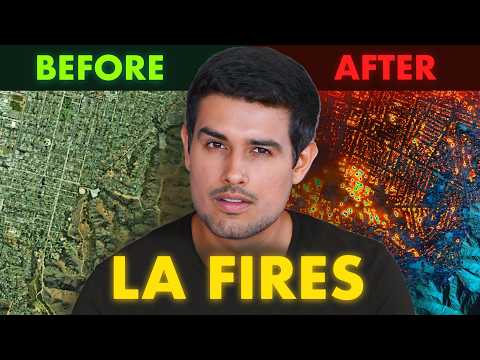
The recent wildfires in Los Angeles have caused unprecedented destruction, displacing over 180,000 people and resulting in significant economic losses. Experts attribute these fires to a combination of climate change, human activity, and extreme weather conditions, highlighting the urgent need for action against climate change.
Los Angeles, known as the home of Hollywood, has faced numerous disasters in films, from earthquakes to alien invasions. However, the recent wildfires have brought a terrifying reality to this city, with scenes that are truly heart-wrenching. A fire tornado was spotted in the Pacific Palisades area, captured by a man who remained trapped in his home as flames surrounded him. Thankfully, he was rescued in time, but not everyone has been so fortunate.
As of now, at least 24 lives have been lost, and the fire has spread across approximately 40,000 acres. Over 12,000 buildings have been destroyed, leaving more than 180,000 people displaced. Evacuation notices have been issued to nearly 200,000 residents. According to estimates from JP Morgan, the economic damage could reach $50 billion.
This is not an isolated incident; multiple fires have erupted in various locations. The fires began on January 7 in the Pacific Palisades area, with additional outbreaks in Eaton and Hurst that same night. By January 9, Kenneth was also engulfed in flames, along with other areas like Lydia, Archer, Woodley, and Sunset.
By January 12, the Lidia fire was fully contained, while the Kenneth fire was 90% controlled. However, the Eden fire was only 15% contained, and the Pacific Palisades fire was just 11% under control.
What is shocking about this entire situation is that it is occurring in January, a month typically associated with winter and heavy rainfall in Los Angeles. The occurrence of such devastating wildfires during this time raises questions about the underlying causes.
From a geographical standpoint, the lack of rainfall in Southern California has led to decreased humidity, causing vegetation to dry out. Powerful offshore winds, known as Santa Ana winds, have exacerbated the fire weather conditions. When these winds descend from the mountains, they heat up and can drop humidity levels below 10%, further drying out the forests and increasing the likelihood of wildfires.
The real question is: what is causing these conditions of low rainfall, low humidity, and dry vegetation? Climate scientist Peter Kalmas, who previously lived in Los Angeles, has highlighted the impact of climate change. In an article for the New York Times, he revealed a grim truth about the role of powerful corporations in perpetuating climate change.
According to the Copernicus Climate Change Service, 2023 has been recorded as the hottest year since 1850, with average temperatures 1.48 degrees Celsius higher than pre-industrial levels. The deputy director of this service stated that climate records are falling like dominoes, with 2023 likely to be the hottest year in the last 100,000 years.
The previous record holder for the hottest year was 2016, which has now been surpassed. This is not an isolated incident but rather a tragic trajectory of climate change. By December 2023, greenhouse gas levels and global temperatures reached record highs, while sea ice in Antarctica hit record lows.
The annual climate summit, COP 28, held in December, focused on phasing out fossil fuels. However, by November 2024, during COP 29, it was revealed that emissions from coal, oil, and gas were projected to increase by 0.8% instead of decreasing.
While wildfires can occur naturally, human activities significantly contribute to their frequency and intensity. In California, the triggers for wildfires can be both natural, such as lightning strikes, and man-made, including roadside ignition from vehicles or campfires left unattended. The National Park Service has reported that 85% of wildfires in the U.S. are caused by human actions.
In the case of the Pacific Palisades fire, fireworks from New Year's celebrations are suspected to be a trigger, although the exact cause is still under investigation.
The connection between climate change and the recent wildfires cannot be ignored. A study published in the Proceedings of the National Academy of Sciences indicated that the number of fire weather days in California has increased from 66 to 90 over the past few decades. Furthermore, the frequency of extreme wildfires, those spreading over 10,000 acres, has risen by 25% compared to pre-industrial times.
The California Fire Department's data shows that eight of the ten most devastating wildfires occurred between 2017 and 2024, indicating a troubling trend.
Peter Kalmas, who lived in the village of Alta Dena, recalls how the area was once a paradise, filled with avocado trees and vibrant wildlife. However, as temperatures rose, he felt compelled to leave. After experiencing the devastating Bobcat fire in 2020, he realized that his neighborhood could also fall victim to wildfires.
Kalmas emphasizes that the climate crisis is exacerbated by the actions of a few powerful corporations. A report revealed that 57 companies are responsible for 80% of global greenhouse gas emissions. These include multinational oil, gas, and coal companies that have known about the irreversible effects of climate change for decades but have continued to prioritize profit over the planet.
Documents from the 1950s show that the fossil fuel industry funded research that downplayed the dangers of air pollution and climate change. Despite knowing the risks, these companies have spread misinformation to protect their interests.
Kalmas argues that to combat the climate crisis, society must hold these billion-dollar corporations accountable. He advocates for civil disobedience and urges individuals to join climate activist movements. While personal efforts to live sustainably are important, systemic change is necessary to address the root causes of climate change.
The wildfires in Los Angeles serve as a stark reminder of the urgent need to address climate change. As the planet becomes increasingly uninhabitable, it is crucial for individuals and communities to take action against the powerful entities that contribute to this crisis. The time for change is now, and every effort counts in the fight for a sustainable future.



















