
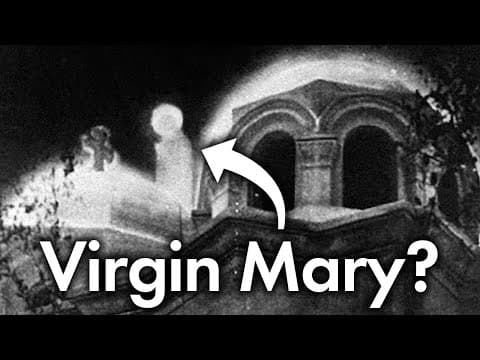
This blog post explores the phenomenon of Marian apparitions, focusing on key events like Fatima and Lourdes, their historical context, and the implications for faith and authority within the Catholic Church. It examines the nature of these visions, their impact on believers, and the church's process for recognizing them, highlighting the tension between grassroots devotion and institutional authority.
On May 13, 1917, amidst the turmoil of World War I, three shepherd children in Fatima, Portugal, claimed to witness a radiant woman, believed to be the Virgin Mary. This event marked the beginning of a series of Marian apparitions that would captivate millions and shape Catholic devotion. This blog post delves into the nature of these apparitions, their historical significance, and the complex relationship between individual experiences and institutional authority within the Catholic Church.
The children, Lucia, Francisco, and Jacinta, reported seeing a beautiful woman holding a rosary, who urged them to pray daily and return to the same spot on the 13th of each month. As their visits continued, the number of witnesses grew, culminating in a gathering of approximately 70,000 people on October 13, 1917. Despite heavy rain, the weather cleared, and many reported witnessing a miraculous solar phenomenon, described as the sun dancing in the sky.
The event drew skepticism from scholars and skeptics, who proposed various natural explanations, such as unusual weather or psychological phenomena. However, for the faithful, the experience remained a profound spiritual event, reinforcing their belief in the apparitions as divine encounters.
Scholar Sandra Zimdar Schwarz defines an apparition as a vision where a being not normally within the visionary's perception appears vividly in the environment, without clear physical cause. This distinguishes Marian apparitions from other religious visions, such as weeping statues or moving icons.
Marian apparitions can be both public and private. Some individuals report solitary visions, while others, like the children at Fatima, experience shared encounters with large crowds. This duality highlights the complex dynamics of faith and authority, as seen in the experiences of visionaries like Estella Ruiz and Maria Pala Auna.
Initially, reports of apparitions primarily involved saints and angels appearing to clergy. However, during the 11th and 12th centuries, sightings of Mary increased, coinciding with a surge in devotion to her. Notable figures like St. Dominic and St. Francis of Assisi reported visions that shaped the Catholic understanding of Mary.
The 19th century saw a resurgence of Marian apparitions, with significant events at Lourdes (1858), La Salette (1846), and Fatima (1917). These apparitions often involved laypeople, including children, and were characterized by multiple appearances, which helped build momentum for pilgrimages and devotion.
Marian apparitions are categorized as private revelations, distinct from public revelation found in scripture. The Church recognizes these apparitions as worthy of belief if they inspire true devotion and do not contradict Catholic teachings.
The Church approaches claims of apparitions with caution, often involving lengthy investigations by local bishops and commissions of experts. The outcomes can range from approval as worthy of belief to outright rejection. Most reported apparitions remain uninvestigated, reflecting the Church's cautious stance.
In 1531, Juan Diego reported an apparition of Mary, who spoke his native language and instructed him to build a church. This event became a symbol of Mexican identity and faith, illustrating how apparitions can empower marginalized voices while also serving colonial interests.
At Lourdes, Bernadette Soubirous reported multiple visions of Mary, leading to the discovery of a spring believed to have healing properties. The site has since become a major pilgrimage destination, attracting millions seeking miraculous cures.
Since 1981, the village of Medjugorje has been the site of ongoing apparitions, with visionaries claiming daily encounters with Mary. Despite skepticism from Church authorities, the site has drawn millions of pilgrims, highlighting the tension between grassroots devotion and institutional oversight.
Marian apparitions have led to the establishment of pilgrimage sites that significantly impact local economies. For instance, Lourdes and Fatima attract millions of visitors annually, reshaping their communities and generating substantial revenue.
The messages conveyed during apparitions often reflect the social and political contexts of their time. For example, the Fatima apparitions occurred during World War I, with messages warning of future conflicts. This connection underscores how Marian apparitions can resonate with contemporary issues and concerns.
Marian apparitions continue to evoke deep faith and devotion among millions. They challenge the boundaries of religious authority, allowing ordinary individuals to become conduits of divine messages. As the Church navigates the complexities of recognizing these phenomena, the legacy of Marian apparitions remains a powerful testament to the enduring influence of faith in the modern world.



















