
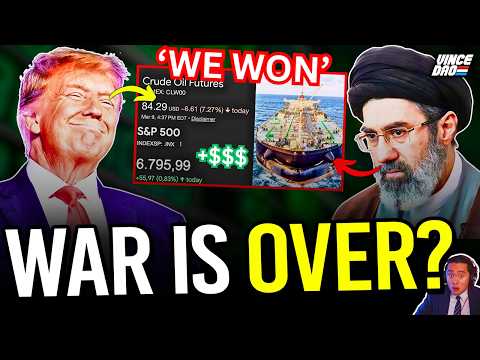
Recent developments indicate that the conflict with Iran is nearing its end, as evidenced by a significant drop in US oil prices and the reopening of the Strait of Hormuz to shipping. President Trump stated that Iran's military capabilities have been largely neutralized, leading to increased investor confidence and market gains. This shift has major geopolitical and economic implications, signaling a return to stability in the Middle East.
Recent key developments have signaled a turning point in the conflict involving Iran. President Trump has declared the war "very complete," citing the neutralization of Iran's military capabilities. This announcement coincides with a stunning drop in US oil prices and the reopening of the critical Strait of Hormuz to shipping traffic, indicating a potential end to regional instability.
Initially, signs pointed towards a de-escalation of the conflict. US oil prices began to drop, and reports emerged that the first large oil tanker had safely crossed the Persian Gulf and the Strait of Hormuz without threats from Iranian forces. This was a significant indicator that the Iranian military threat had been largely neutralized and that the conflict might be coming to an abrupt end.
Despite skepticism and accusations of propaganda, the economic indicators proved otherwise. Following these events, US oil prices plummeted by nearly 30% in a single day, confirming the initial theory that stability was returning to the region.
The Strait of Hormuz is a narrow passage in the Persian Gulf through which a significant portion of the world's oil supply transits. Due to threats from Iran's navy and ballistic missiles, shipping had been largely cut off, causing a global energy crisis.
However, recent data shows dozens of ships, including oil tankers, have been transiting the Strait safely, often turning off their transponders for security reasons. This reopening is a clear sign that the threat from Iran has diminished significantly, restoring confidence in global oil markets.
President Trump stated in interviews that Iran's navy, communications, and air force have been effectively destroyed. The US is reportedly ahead of its initial timeline for the operation, which was estimated to take four to five weeks.
The lack of ballistic missile launches from Iran further supports the claim that their military capabilities have been severely degraded. This military success has directly contributed to the reopening of the Strait of Hormuz and the subsequent drop in oil prices.
Following the announcement and the reopening of the Strait, US crude oil prices fell dramatically from over $100 per barrel to around $86 per barrel, marking one of the largest daily reversals in recent history.
Stock markets also responded positively. The S&P 500 erased earlier losses and gained 0.7% after President Trump's statement, reflecting increased investor confidence that the conflict will not lead to a prolonged energy crisis.
The swift resolution of the conflict has broader geopolitical consequences. Russian President Vladimir Putin had anticipated a halt in oil production through the Strait of Hormuz, which would have pressured Europe to seek energy supplies from Russia. However, the reopening of the Strait has thwarted this strategy.
Furthermore, the neutralization of Iran and Venezuela, two key allies of China, disrupts China's strategic positioning in the Middle East and Latin America. This shift affects China's calculus regarding potential conflicts, such as a hypothetical invasion of Taiwan.
Securing the Strait of Hormuz is crucial not only for current energy prices but also for future national security. The potential for Iran to develop nuclear weapons remains a concern, as it could alter the strategic balance and complicate future conflicts.
By neutralizing Iran's military capabilities now, the US aims to prevent scenarios where Iran could threaten global shipping lanes during larger conflicts, such as a possible World War III involving China and its allies.
The recent developments indicate that the conflict with Iran is nearing its end, with significant military and economic victories for the US and its allies. The reopening of the Strait of Hormuz and the sharp decline in oil prices reflect restored stability in the Middle East.
President Trump's declaration that the war is "very complete" aligns with these economic and geopolitical indicators. While some uncertainty remains, the signs point towards a major political and strategic success that could influence global markets and international relations for years to come.
This situation underscores the importance of monitoring economic indicators, such as oil prices and shipping activity, to assess geopolitical events accurately. The swift resolution of this conflict challenges previous predictions of a prolonged energy crisis and highlights the dynamic nature of global politics.
As the situation continues to evolve, it will be essential to watch how these developments impact future US foreign policy, energy markets, and international security.
What are your thoughts on the recent developments in the Iran conflict and their impact on global markets? Share your views in the comments below.



















