
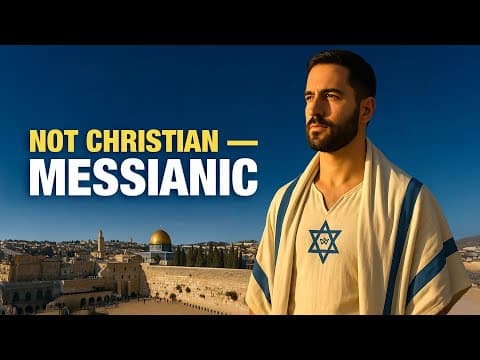
The term "Christian" was first used by outsiders to describe the followers of Jesus in Antioch, but the early believers identified as "saints," "the faithful," and "the assembly," remaining rooted in Jewish tradition. They saw Jesus (Yeshua) as the Jewish Messiah, not founders of a new religion. Over time, Christianity diverged from its Jewish origins, but rediscovering Messianic Judaism reveals the original faith and mission of Jesus' followers.
The followers of Jesus did not originally call themselves Christians. The term "Christian" was first used in Antioch, as recorded in Acts 11:26: "The disciples were first called Christians in Antioch." However, this label was given by outsiders, not by Jesus or the apostles themselves. Instead, early believers referred to themselves as "the saints," "the faithful," or "the assembly."
Today, billions identify as Christians, with churches, nations, and even wars shaped by this identity. But what if we reconsider the origins of this faith? Did the first followers of Yeshua (Jesus) ever use the term "Christian" for themselves? The answer challenges many common assumptions.
Acts 11:26 is the only New Testament verse that directly mentions when the term "Christian" first appeared. It states that the disciples were called Christians in Antioch, but crucially, it was a name given by others, not a self-designation.
Antioch was a major Roman city, far from Jerusalem and the Jewish heart of the early movement. Scholars agree that the term was likely coined by Romans or Greeks observing this new Jewish sect. They labeled the followers based on their constant talk about the Messiah, or "Christ."
The Greek word "Christianos" literally means "one who belongs to Christ." However, for the early Jewish followers of Yeshua, "Christ" was not merely a name but a title derived from the Hebrew "Mashiach" (משיח), meaning "Anointed One."
In Hebrew culture, the Mashiach referred to the promised king descended from David, who would redeem Israel and establish God's kingdom on earth. When early believers called Yeshua the Christ, they were declaring him as the Jewish Messiah foretold by Moses, Isaiah, and other prophets.
Over time, the term "Christian" evolved to mean something different. It became detached from its Jewish roots and came to represent a new religion separate from Israel, with its own traditions, theology, holidays, and often hostility toward the Jewish people.
This was not how the faith began. The apostles, including Paul, never used the term "Christian" in their letters. Instead, Paul referred to believers as:
These terms reflect a community that did not see itself as leaving Judaism but as fulfilling it through belief in Yeshua as the Messiah.
The early followers of Yeshua were essentially Messianic Jews—Jews who believed the Messiah had come. Gentiles who joined them were grafted into the commonwealth of Israel, not into a new religion.
Ephesians 2:12–13 explains this inclusion: "You were without Christ, being aliens from the commonwealth of Israel. But now in Christ Jesus, you who once were far off have been brought near by the blood of Christ."
In Hebrew, followers of Yeshua who embraced his identity as the Messiah would be called "Notzrim Meshichiim" (נוֹצְרִים מְשִׁיחִיִּים), meaning "Messianic believers." They did not reject the Torah, the Sabbath, or the God of Israel; rather, they embraced these more deeply through the lens of the Messiah.
Acts 24:14 records Paul saying, "According to the way which they call a sect, so I worship the God of my fathers, believing all things which are written in the law and in the Prophets."
By the time of the Church Fathers—such as Justin Martyr, Origen, and Augustine—the gap between Christianity and its Jewish foundation had widened significantly. Key changes included:
The term "Christian" became not just a label but often a weapon used against the Jewish people.
Understanding this history affects how we read scripture, view Yeshua, and define faith. The label "Christian" is not wrong, but it is not original. Starting from the wrong foundation can lead to a faith that looks very different from what Yeshua intended.
Jesus did not come to start a new religion but to fulfill God's promises to Israel and open the gates of that kingdom to the nations.
John 4:22 states, "Salvation is of the Jews."
Romans 11:1 asks, "Has God cast away His people? Certainly not! For I also am an Israelite."
Before defining ourselves by a term that was not theirs, we should ask:
The early followers of Yeshua had a mission and a calling. They were part of a covenant, seeing themselves as the faithful remnant of Israel and the first fruits of a global harvest.
The gospel did not begin in Rome, Europe, church buildings, councils, or cathedrals. It began in Jerusalem with Jewish men and women who followed their Jewish Messiah. When the nations joined, they were invited not to erase that story but to become part of it.
If you believe in Jesus, Yeshua, the Jewish Messiah, ask yourself: Are you following him as He truly is, or a version shaped by history?
The word "Christian" is a useful label but not the original identity of the faith. Perhaps it is time to rediscover the original language of faith—not just in words but in heart, identity, and mission.
The truth remains unfiltered and rooted in the Messianic Jewish faith that first embraced Yeshua as the promised Messiah of Israel.



















