
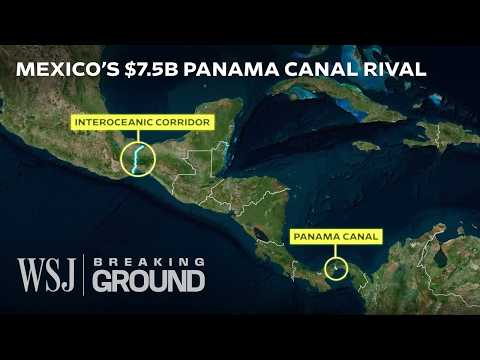
Mexico is investing $7.5 billion in the Interoceanic Corridor to create a new shipping route that could alleviate congestion in the Panama Canal. This railway aims to connect the Atlantic and Pacific Oceans, but its success depends on modernization and collaboration with existing routes.
For decades, the Panama Canal has been a crucial artery for global trade, facilitating the movement of billions of dollars worth of goods. However, rising toll prices and low water levels have made this route less reliable. In response, Mexico is investing $7.5 billion in the Interoceanic Corridor, a railway designed to connect the Atlantic and Pacific Oceans and potentially disrupt the shipping status quo.
Shipping goods efficiently is vital for companies, especially when transporting large volumes like 10,000 containers from Shanghai to New York. The Panama Canal, once the preferred route, has raised toll prices nearly eightfold and restricted the size and number of ships that can pass through due to historically low water levels. As a result, companies face the dilemma of either rerouting via Cape Horn, which adds nearly 8,000 miles to their journey, or seeking alternatives like Mexico's new corridor.
The Interoceanic Railway, which stretches 188 miles across the Isthmus of Tehuantepec, was originally opened in 1907 to transport goods like Hawaiian sugar. However, it fell out of favor after the Panama Canal opened, offering a more attractive route for American businesses. Today, reviving this railway is part of a broader strategy by the Mexican government to distribute wealth across the country, particularly in the impoverished southern states of Veracruz and Oaxaca.
The new corridor aims to carry both passengers and cargo across ten stops between the Atlantic and Pacific ports. The Mexican government plans to build ten industrial complexes along the route, which could include factories for car parts and agricultural products. This initiative is expected to attract significant investment, with approximately $6 billion in funding from the Mexican government and over $2 billion from international sources, including the World Bank.
Despite the ambitious plans, several challenges remain. The complexity of global supply chains means that time, money, and shipping capacity are critical factors. While the Panama Canal takes about 8 to 10 hours to navigate, the railway could take 6 to 7 hours. However, when factoring in the time required to load and unload containers, the total time could extend to 15 hours. Additionally, the railway's capacity is projected to be less than half that of the Panama Canal, which currently handles a significant portion of global trade.
As companies look to reduce reliance on distant suppliers, the concept of nearshoring—relocating supply chains closer to home—has gained traction. Mexico's proximity to the United States positions it as an attractive option for businesses seeking to move operations closer to their markets. The corridor could facilitate the production of essential goods, such as semiconductors, which are critical for various industries, including automotive and technology.
While the corridor presents economic opportunities, it also raises concerns. Indigenous communities along the railway route have reported forced relocations, and environmentalists warn of potential ecological impacts. The project’s implications extend beyond economics, affecting the lives of local populations and the environment.
As of late 2023, freight and passenger services have begun on the first section of the railway, but significant upgrades are still needed to fully realize its potential. The Panama Canal Authority remains confident in its route, emphasizing its ongoing monitoring of competing projects. However, experts suggest that collaboration between Mexico and Panama could enhance the efficiency of global supply chains, allowing both routes to coexist and serve international trade needs.
In conclusion, while Mexico's Interoceanic Corridor may not replace the Panama Canal, it represents a significant step towards diversifying global shipping routes and could play a vital role in the future of international trade.



















