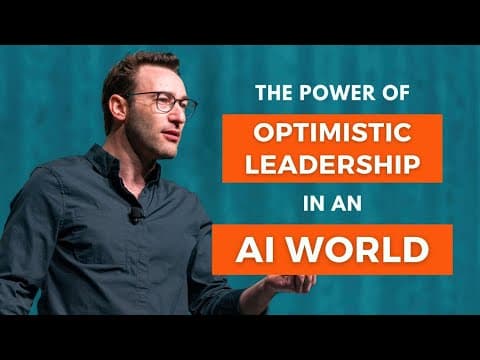
In a conversation with Simon Sinek, the complexities of leadership in the era of AI are explored, emphasizing the importance of realistic optimism, human connection, and the evolving nature of trust in organizations. Sinek discusses the need for empathy in leadership, the impact of generational differences in the workforce, and the necessity of fostering a culture of vulnerability and growth.
In a recent conversation, Simon Sinek shared his thoughts on leadership in the context of the current global challenges, including economic uncertainty, social crises, and the rise of artificial intelligence (AI). His insights delve into the essence of optimism, the importance of human connection, and the evolving dynamics of trust within organizations.
Sinek begins by addressing the concept of optimism, clarifying that it should not be confused with blind positivity. He emphasizes that true optimism acknowledges the difficulties and challenges we face while maintaining a belief in a brighter future.
"An optimist would say we are in a dark tunnel. I do not know how long we will be in here, but I know that if we work together, we will get through this and emerge stronger."
This perspective is crucial for leaders, as it allows them to be realistic about the challenges while inspiring their teams to collaborate and find solutions.
Sinek highlights that humans are inherently social beings, and the decline of interpersonal skills due to technological advancements poses a significant challenge. He notes that the way we interact with news and social media has changed, often leading to a lack of genuine connection.
"We have to remember that human beings are social animals. What makes us happy and healthy is human interaction."
In the context of AI, Sinek argues that while technology can enhance our lives, it can also threaten our ability to connect meaningfully with others. The challenge lies in ensuring that technology serves to foster relationships rather than replace them.
The conversation shifts to the topic of trust, particularly in the wake of declining confidence in public institutions. Sinek points out that businesses are currently viewed as more trustworthy than governments, which presents both an opportunity and a challenge for organizations.
"Business is the only institution viewed as both competent and ethical."
However, he cautions against complacency, suggesting that trust is relative and can shift based on societal changes. Leaders must actively work to build and maintain trust within their teams, especially as AI becomes more integrated into the workplace.
Sinek discusses the generational differences in the workforce, particularly focusing on Millennials and Generation Z. He notes that while these younger generations bring valuable skills and perspectives, they also face unique challenges, including anxiety and a sense of entitlement.
"This young generation is starting work with a knowledge of technology and personal branding, which can create a warped sense of value."
To effectively lead these generations, Sinek emphasizes the need for empathy and understanding from older leaders. He believes that fostering an environment where young employees feel safe to express their vulnerabilities is essential for their growth and success.
Sinek advocates for creating a culture where vulnerability is seen as a strength rather than a weakness. He suggests that organizations should encourage employees to ask for help and admit mistakes without fear of retribution.
"When we talk about being in a circle of safety, it means I can raise my hand and say I made a mistake without fear of humiliation."
This culture of psychological safety not only enhances individual well-being but also contributes to overall team performance.
The conversation also touches on the contentious topic of performance appraisals. Sinek argues that traditional appraisal systems often fail to capture the true essence of an employee's contributions and growth. He suggests a shift towards evaluating not just performance but also trust and character.
"We need to balance metrics of performance with metrics of character and trustworthiness."
By implementing 360-degree feedback systems that focus on growth and development, organizations can create a more supportive environment for their employees.
As AI continues to evolve, Sinek expresses optimism about its potential to create upward mobility in the workforce. He believes that while AI may displace certain jobs, it also opens up new opportunities for growth and advancement.
"We have a unique opportunity to bridge the divide created by past technologies."
However, he cautions that the narrative surrounding AI must be handled with care, emphasizing the need for empathy in communicating these changes to the workforce.
In conclusion, Simon Sinek's insights into leadership in the age of AI highlight the importance of realistic optimism, human connection, and trust within organizations. As leaders navigate these complexities, fostering a culture of vulnerability and growth will be essential for success in an increasingly digital world. By prioritizing empathy and understanding, organizations can create environments where all employees can thrive, regardless of their generational background or the technological landscape.