
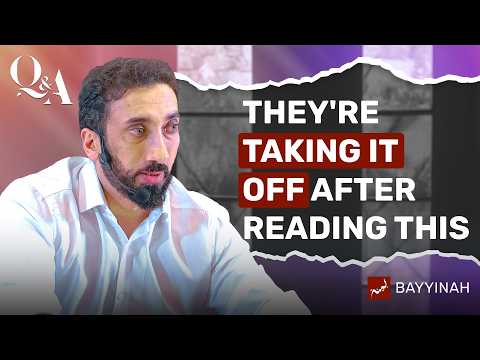
In a recent Q&A session, Nouman Ali Khan discusses the motivations behind women removing their hijabs, the importance of intellectual honesty in Islamic discourse, and the need for deeper engagement with religious texts and historical context.
In a thought-provoking Q&A session, Nouman Ali Khan addresses the sensitive topic of women removing their hijabs, exploring the motivations behind such decisions and the broader implications for intellectual discourse within the Muslim community.
Khan begins by acknowledging that the decision to remove the hijab can stem from various influences, including interpretations of Islamic teachings. He emphasizes that some women may choose to take off their hijabs not out of a desire for beautification but due to newfound interpretations that suggest it is not obligatory. This raises the question of how individuals can navigate these interpretations while remaining true to their beliefs.
Khan points out that many women who previously wore the hijab may have been influenced by scholarly articles and discussions that challenge traditional views. He notes that while he has not yet read a specific paper on this topic, he is open to engaging with new ideas and interpretations. He stresses the importance of honesty in examining both textual evidence from the Quran and historical context, warning against selective citation that can lead to misleading conclusions.
Khan argues that the Muslim community must elevate its discourse around such topics. He believes that simply dismissing new ideas as heretical or incorrect does not contribute to a constructive dialogue. Instead, he advocates for a more rigorous examination of evidence and arguments, encouraging Muslims to engage deeply with the texts and the historical context surrounding them.
He acknowledges that the motivations behind a woman's decision to remove her hijab may not solely be based on scholarly articles. Instead, they may reflect a broader desire for autonomy or a response to societal pressures. Khan highlights a common psychological phenomenon where individuals seek validation for their choices through external sources, such as scholarly papers, rather than engaging with the material themselves.
Khan emphasizes that the Muslim community should strive for a higher level of intellectual engagement. He encourages individuals to critically assess the arguments presented in scholarly works, rather than accepting them at face value. This approach not only fosters a deeper understanding of the faith but also empowers individuals to form their own opinions based on thorough research and contemplation.
He warns against the tendency to rely on the opinions of popular figures or scholars without critically evaluating their arguments. Khan reflects on his own experiences, noting that while he appreciates the support of his audience, he urges them to prioritize the substance of the arguments over the personalities behind them. This shift in mindset is crucial for fostering a more informed and engaged community.
In conclusion, Nouman Ali Khan's insights into the complexities surrounding the hijab and the importance of intellectual honesty serve as a call to action for the Muslim community. By encouraging deeper engagement with religious texts and fostering open discussions about interpretations, Khan advocates for a more nuanced understanding of faith that respects individual choices while remaining rooted in scholarly rigor.
As the discourse around the hijab continues to evolve, it is essential for individuals to seek knowledge, engage with diverse perspectives, and cultivate a culture of intellectual honesty within the community.



















