
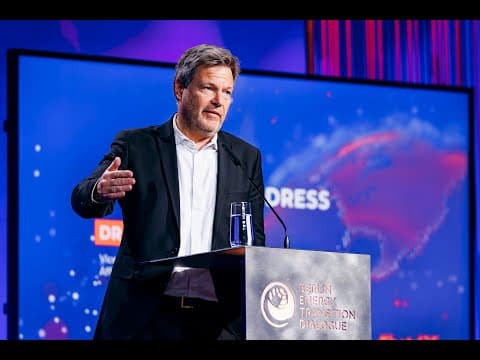
In his address at the Berlin Energy Transition Dialogue 2025, Minister Habeck discusses the intersection of freedom, conflict, and energy policy, emphasizing the need for a shift towards renewable energy to ensure both energy security and climate protection. He highlights the lessons learned from Germany's energy transition and the importance of international cooperation in addressing global challenges.
In a world increasingly marked by conflict and crises, German Minister Habeck addressed the Berlin Energy Transition Dialogue 2025, emphasizing the complex interplay between freedom, military conflict, and energy policy. His insights reflect on Germany's historical context and the urgent need for a global shift towards renewable energy.
Minister Habeck began by acknowledging the diverse political cultures and histories that shape nations. He pointed out that Germany's experience, particularly its two world wars, has fostered a strong democratic ethos and a cautious approach to military engagement. This historical backdrop informs Germany's perspective on international relations and conflict resolution.
He articulated a critical conflict line that has emerged in recent years: the tension between freedom and violence. The post-Cold War era brought hopes of a cooperative global order, where nations would engage diplomatically to resolve conflicts. However, Habeck noted that this order is increasingly under threat as geopolitical interests and military conflicts overshadow collaborative efforts.
A significant part of Habeck's address focused on the misconception of freedom. He argued that true freedom does not equate to a lack of rules or responsibilities. Instead, it involves making collective decisions about how to govern and interact with one another, both domestically and internationally. This misunderstanding has led to a rise in conflicts, as nations resort to violence rather than dialogue to assert their interests.
Habeck connected the dots between energy policy and conflict, asserting that energy dependence can exacerbate tensions. He emphasized the importance of diversifying energy sources to enhance security and resilience. Germany's experience as an energy-importing nation has taught valuable lessons about the risks of over-reliance on single sources or partners.
He urged countries, both importers and exporters, to diversify their energy relationships to foster stability and cooperation. This approach not only mitigates risks but also promotes fair trade practices and strengthens international ties.
A central theme of the conference was the urgent need to transition away from fossil fuels. Habeck highlighted Germany's progress in increasing its renewable energy share from 40% to nearly 60% in just three years. This shift not only reduces dependence on fossil fuels but also contributes to energy security and economic benefits by keeping revenues within the country.
He cautioned against repeating past mistakes by exporting fossil fuel dependency to other regions, particularly in sun-rich continents like Africa. Instead, he advocated for leveraging renewable energy sources such as wind and solar to build resilient energy systems that do not rely on imports.
Habeck underscored the critical link between energy policy and climate protection. He framed the fight against climate change as a historical responsibility for current political leaders. The urgency of addressing climate issues is not just a future concern; it is a present-day challenge that affects lives globally.
He referenced a landmark ruling by the German Constitutional Court, which mandates that the government must ensure the freedom of future generations by actively contributing to climate protection. This obligation extends beyond mere compliance; it is about safeguarding the ability of people to live freely and self-determined lives.
In conclusion, Minister Habeck's address at the Berlin Energy Transition Dialogue 2025 serves as a powerful reminder of the interconnectedness of freedom, conflict, and energy policy. He called for a renewed commitment to expanding renewable energy and addressing climate change as foundational elements for a future where free and self-determined choices are possible.
The path forward requires not only technological advancements but also a collective effort to engage in dialogue and cooperation across borders. As nations navigate these challenges, the lessons learned from Germany's energy transition can provide valuable insights for a more sustainable and peaceful world.



















