
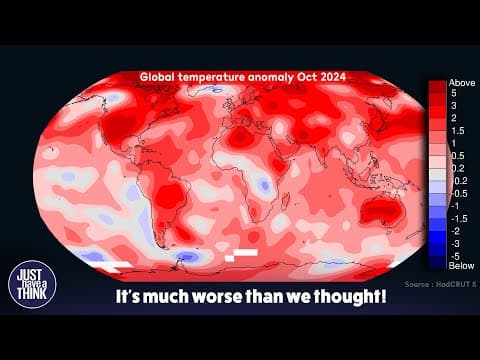
Recent research indicates that global warming is accelerating, with the planet's average surface temperature rising at a rate of 0.4 degrees Celsius per decade. This acceleration is attributed to a combination of factors, including the influence of El Niño, volcanic activity, and solar variations. Despite short-term fluctuations, the long-term trend shows a significant increase in warming, raising concerns about exceeding the 1.5 degrees Celsius limit set by the Paris Agreement by late 2026.
In recent years, climate scientists have been closely monitoring the effects of the Pacific Ocean's circulatory system, known as ENSO (El Niño Southern Oscillation), on global temperatures. The current El Niño phase, which began in 2023, has significantly influenced climate patterns, contributing to a dramatic spike in ocean and atmospheric temperatures. This blog post delves into the latest research that reveals our planet is warming at an alarming rate, potentially twice as fast as previously estimated.
The ENSO system oscillates between La Niña, neutral, and El Niño phases, each affecting global temperatures differently. While La Niña tends to cool the climate, El Niño has a warming influence. The recent El Niño phase has acted as a turbo boost for planetary warming, leading to concerning temperature increases over the past eighteen months. However, these fluctuations are part of natural cycles that have occurred for millions of years.
In addition to ENSO, other factors such as solar luminosity and volcanic activity also play significant roles in temperature variations. Volcanic eruptions release sulfur dioxide, which can cool the Earth's surface by reflecting sunlight back into space. These natural phenomena can skew decadal trends in global temperatures, making it challenging to discern long-term patterns.
To accurately assess the long-term trend of global warming, researchers Stefan Rahmstorf and Grant Foster conducted a comprehensive analysis of historical temperature data. They aimed to filter out short-term anomalies caused by natural variability to reveal the underlying trend.
Since the 1970s, the mean surface temperature of the Earth has risen at an average rate of approximately 0.2 degrees Celsius per decade. However, brief periods of temperature fluctuations, such as the early 2000s slowdown known as "the pause," have led to misconceptions about the long-term trend. Rahmstorf and Foster emphasize that these fluctuations should not be mistaken for a change in the overall warming trajectory.
The researchers employed several statistical techniques to analyze temperature data from five reputable sources, including NASA and NOAA. They utilized Change Point Analysis (CPA) to identify significant shifts in the warming trend and to distinguish between natural variability and human-induced changes.
The findings suggest that while the world may not be on an immediate path to catastrophic climate events, the acceleration of global warming is undeniable. If current trends continue, we could exceed the 1.5 degrees Celsius limit set by the Paris Agreement by late 2026.
Rahmstorf and Foster's research highlights the necessity of rigorous data analysis in understanding climate trends. By removing the noise created by natural variability, they were able to reveal a clearer picture of the acceleration in global warming. This underscores the importance of relying on scientific methods to inform climate policy and public understanding.
The recent research conducted by Rahmstorf and Foster provides critical insights into the accelerating pace of global warming. While the immediate future may not seem dire, the potential for rapid temperature increases poses significant risks. It is essential for policymakers and the public to recognize the urgency of addressing greenhouse gas emissions to mitigate the impacts of climate change. As we move forward, continued research and data analysis will be vital in shaping our response to this global challenge.



















