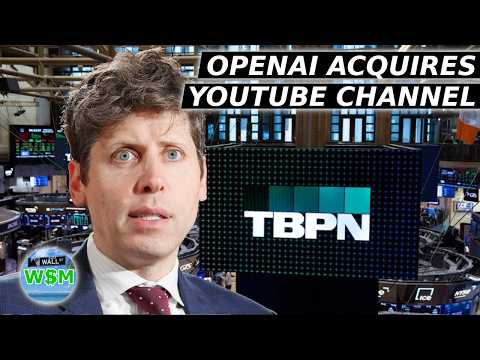
OpenAI acquired the technology-focused YouTube channel TBPN for hundreds of millions, a move that seems strategic rather than purely financial. TBPN, with 79,000 subscribers and nearly 1 million monthly views, targets high-value tech executives and startup founders, making it a valuable platform for OpenAI's enterprise products. The acquisition may also support OpenAI's upcoming IPO by leveraging TBPN's influence in tech and finance circles.
On April 2nd, 2026, OpenAI announced its acquisition of TBPN, a technology-focused podcast and YouTube channel. This surprising move raised many questions, particularly about why an AI company would acquire a YouTube channel and the hefty purchase price involved. According to the Financial Times, the acquisition cost was in the low hundreds of millions of dollars.
TBPN stands for the Technology Business Programming Network. It was founded by Jordy Hayes and John Kugan, both veterans of Silicon Valley. Kugan co-founded the meal replacement company Soylent and worked at Peter Thiel's venture capital firm, Founders Fund. Hayes founded Branded Native, an advertising agency specializing in YouTube channels. Their combined experience and connections in Silicon Valley and venture capital allowed TBPN to secure interviews with startup founders, venture capitalists, and major tech CEOs, including frequent guest Sam Altman.
TBPN produces a three-hour daily live show on YouTube, also available on Spotify and other podcast platforms. Each episode typically attracts a few thousand live viewers, with clips garnering similar views. The channel has 79,000 subscribers and receives just under 1 million views monthly, though viewership fluctuates.
The show focuses heavily on AI and technology news, appealing primarily to technologists in Silicon Valley. TBPN employs 11 people, including video editors and administrative staff who manage guest appearances.
Despite its relatively small audience, TBPN is on track to generate $30 million in revenue in 2026, mostly from brand sponsorships. This is an unusually high revenue figure for a podcast of its size. Sponsors are primarily enterprise tech and fintech companies, such as the fintech firm RAMP.
The value of TBPN's audience lies in its composition: startup founders, tech executives, and other high-value individuals. For example, if a corporate executive discovers RAMP through TBPN and adopts it for their company, the resulting business could be worth tens or hundreds of thousands of dollars. This justifies the high cost per view for sponsors, who only need to convert a few high-value customers to cover their advertising expenses.
The Financial Times reported the purchase price as being in the low hundreds of millions. Given TBPN's projected $30 million revenue and small team, the valuation is not unreasonable. The acquisition was likely paid mostly in OpenAI stock, which has a private market valuation of approximately $850 billion. Exchanging a tiny fraction of this stock for a profitable business like TBPN could make financial sense.
However, in the context of OpenAI's massive expenditures—burning tens of billions annually—the acquisition's financial impact is minimal. The strategic value of TBPN is likely the primary motivation.
TBPN covers the AI industry extensively, including OpenAI and its competitors. Sam Altman, OpenAI's CEO, has expressed that TBPN will maintain editorial independence despite the acquisition. However, given the overlap, there is a clear conflict of interest.
One possible rationale is that TBPN serves as a platform to subtly promote OpenAI's enterprise products to a highly relevant audience of startup CEOs and tech executives. This mirrors a similar strategy employed by HubSpot, which acquired The Hustle, a media company with a business-focused newsletter and YouTube channel.
In 2021, HubSpot acquired The Hustle for $27 million. The Hustle produces business and entrepreneurship content, including YouTube videos and research reports. While The Hustle's YouTube channel is not a direct profit center, it serves as a top-of-funnel advertising channel to attract small business owners and entrepreneurs who are potential customers for HubSpot's CRM software.
Similarly, OpenAI may use TBPN to reach potential enterprise customers by engaging an audience interested in technology and AI.
OpenAI plans a massive IPO by the end of 2026. CEO Sam Altman is eager to proceed quickly, but CFO Sarah Frier has expressed concerns about the company's readiness, particularly regarding the disclosure of hundreds of billions in data center spending commitments with partners like Oracle, Microsoft, and Google. These financial risks could deter investors and impact OpenAI's stock price.
The relationship between Altman and Frier has reportedly deteriorated, with Altman excluding Frier from investor meetings, which is unusual for a CFO.
TBPN could play a role in supporting the IPO by providing coverage and visibility. The channel has a partnership with the New York Stock Exchange, allowing it to broadcast live from the trading floor during high-profile tech IPOs. TBPN's audience includes wealthy venture capitalists and tech investors who might be interested in investing in OpenAI.
Even neutral coverage of the IPO on TBPN could generate significant attention and interest among potential investors.
OpenAI's acquisition of TBPN, while initially puzzling, aligns with strategic objectives beyond immediate financial returns. TBPN offers access to a niche, high-value audience of tech leaders and investors, making it a valuable asset for promoting OpenAI's enterprise offerings and supporting its upcoming IPO.
The acquisition also reflects a broader trend of tech companies acquiring media platforms to enhance their marketing and investor relations capabilities.
What are your thoughts on OpenAI's acquisition of TBPN? Share your views in the comments below.
Wall Street Millennial signing off.