
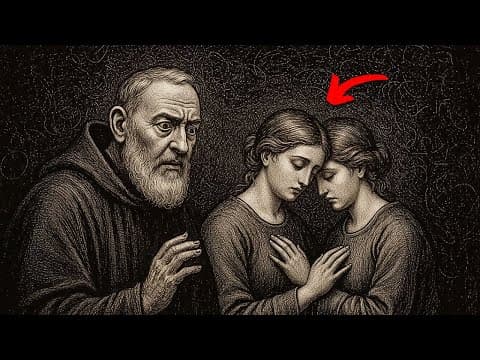
Padre Pio, a 20th-century Italian saint, bore the stigmata and possessed the supernatural ability to see the true state of souls during confession. Over 50 years, he heard around 5 million confessions, revealing hidden sins and foreseeing souls' destinies. His life of suffering, visions, and miracles transformed a small village into a pilgrimage site and left a profound spiritual legacy.
Have you ever wondered what a saint perceives when looking at your soul? Not the outward appearance or the stories you tell yourself, but the true, immortal state of your soul standing naked before God? Throughout the 20th century, millions journeyed to a small mountain village in southern Italy to kneel before a man who could see exactly that.
This man was Padre Pio of Pietrelcina, a Capuchin friar who bore the wounds of Christ for 50 years and heard the confessions of approximately five million people. He saw their lies before they spoke them, uncovered hidden sins from decades past, and sometimes glimpsed where their souls were headed after death.
Francesco Forgione was born on May 25, 1887, in the tiny farming village of Pietrelcina, southern Italy. His parents, Grazio and Maria Giuseppa, were peasant farmers who owned almost nothing. Life was harsh; death was a constant presence, with two of Francesco's seven siblings dying in infancy.
From a young age, Francesco showed a deep religious devotion. By age five, he told his parents he would dedicate his life to God. Unlike many religious children, Francesco truly meant it. He began performing private penances, such as sleeping on stone floors and fasting on feast days, driven by a mysterious inner force.
At 15, he joined the Capuchin order and took the name Pio, after Pope Pius I, symbolizing his devotion. He was ordained a priest in 1910 at age 23.
In 1910, while praying alone, Pio experienced the first appearance of the stigmata—the wounds of Christ's crucifixion—on his hands and feet. These wounds bled and caused him great pain. He begged God to remove them, and they temporarily disappeared.
World War I interrupted his life. Drafted in 1915 for medical service, Pio's health quickly deteriorated due to tuberculosis and high fevers. He was discharged in 1918, declared permanently unfit for service, and returned to the Capuchin friary at San Giovanni Rotondo, a small village perched on Mount Gargano.
On August 5, 1918, while praying alone in the church, Pio experienced a vision of Christ wounded and bleeding. Christ pierced Pio's left side with a lance, leaving a physical wound that bled for seven weeks. This mystical piercing of the heart, called transverberation, symbolized a profound union with God through suffering.
On September 20, 1918, Pio had another vision of Christ suspended on the cross, with rays of fire streaming from the five wounds. These rays struck Pio's hands, feet, and side, causing him to scream in pain. Blood poured from these wounds, which remained open and bleeding for the rest of his life—about 50 years.
The wounds were perfectly round, went completely through his hands, never became infected, and emitted a fragrance of roses and flowers, baffling doctors who found no medical explanation.
By 1919, news spread of a priest in the mountains who bled like Christ. People began arriving—first in small numbers, then by the hundreds and thousands—from across Italy, Europe, and the world. They came to see the wounds, seek miracles, and most importantly, confess their sins to a man reputed to read souls.
From 1918 to 1923, Padre Pio heard confessions for 15 to 19 hours daily, averaging three minutes per confession. In 1962 alone, 83,000 people registered to confess to him, averaging 273 confessions per day. Over his lifetime, he heard an estimated five million confessions.
Padre Pio's confessional was a place of spiritual confrontation and healing. His supernatural ability to see souls was well documented:
A German spiritualist came to challenge him but left converted after Pio accurately recited his sins with dates and circumstances the man had never spoken aloud.
A priest confessed to Pio, who then revealed details about the priest's actions that he had forgotten, such as sleeping in a hotel instead of waiting for mass.
An Italian marine, preparing to move to Australia, was unable to confess. Pio spoke for him, naming four major sins the man had tried to hide. The marine later testified that he understood what it meant to live by faith and stayed in Italy, avoiding catastrophes Pio had foreseen.
An English woman was initially refused confession for 20 days because she was not yet truly repentant. When Pio finally absolved her, she had completely rejected her past life and was restored to grace.
Padre Pio's life was marked by extraordinary suffering, mystical experiences, and a profound spiritual ministry. His wounds, visions, and ability to read souls drew millions to San Giovanni Rotondo, transforming a quiet village into a major pilgrimage site.
His ministry emphasized the power of confession, repentance, and living a life of faith. Through his suffering and compassion, he became a beacon of hope and spiritual guidance for countless souls.
Padre Pio died in 1968, but his legacy endures, inspiring devotion and faith worldwide. His life reminds us of the profound mysteries of the soul and the transformative power of grace and suffering united in love.
This comprehensive account of Padre Pio's life and ministry is based on extensively documented sources, including Bernard Ruffin's definitive biography and Father Stefano Manelli's first-hand accounts, drawing from historical records, witness testimonies, and the saint's own letters.



















