
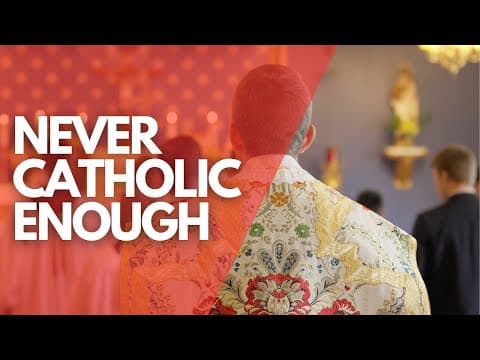
Diane Montana's recent revelations about Pope Francis' rationale for canceling the traditional Latin mass highlight significant discrepancies between the Vatican's claims and the actual sentiments of bishops. This situation underscores the ongoing struggle between traditionalist Catholics and modernist interpretations of communion within the Church.
In a recent development, respected Catholic journalist Diane Montana has unveiled documents that suggest the rationale behind Pope Francis' 2021 decision to cancel the traditional Latin mass (TLM) was based on misleading information. This revelation raises critical questions about the nature of communion within the Church, particularly regarding traditionalist Catholics and their relationship with modernist interpretations of faith.
The document released by Montana indicates that the decision to restrict the TLM was purportedly based on feedback from bishops, who claimed that these communities were causing division within the Church. However, many traditional mass attendees have observed the opposite: that TLM communities often foster family unity and spiritual growth. The reality, as reported by Montana, contradicts the narrative presented by the Vatican.
When the motu proprio Traditionis Custodes was issued, it was accompanied by a survey sent to bishops. The expectation was that this survey would reveal widespread discontent with TLM communities. Contrary to this expectation, the feedback from bishops was largely positive, indicating satisfaction with the presence of TLM in their dioceses. Many bishops recognized that these communities contributed positively to parish life, often preferring them over the Society of St. Pius X (SSPX), which has been viewed with suspicion by some in the hierarchy.
A particularly intriguing aspect of the documents pertains to the SSPX. The bishops' reports suggest a need to protect stable TLM communities to prevent departures toward schismatic groups, including the SSPX. This raises a complex issue: the document implies a distinction between schismatic communities and the SSPX, which is not traditionally recognized in Catholic theology.
The documents also state that the SSPX has not returned to full communion with the Church, yet they are not classified as schismatic. This creates a paradox within modern ecclesiology, where individuals can be considered partially in the Church but not fully reconciled. This modernist perspective complicates the traditional understanding of communion, which historically has been binary: one is either in the Church or outside of it.
The confusion surrounding communion is rooted in a broader modernist interpretation of tradition. Vatican II introduced a notion of tradition that suggests a dynamic understanding of faith, where insights evolve over time. This contrasts sharply with the traditional view that sees doctrine as fixed and unchanging.
Pope Benedict XVI articulated this shift, suggesting that the Church's understanding of truth must adapt to contemporary thought. This has led to a situation where traditionalists feel increasingly alienated, as their practices and beliefs are often viewed as outdated or insufficiently aligned with the modern Church's direction.
For traditionalist Catholics, the implications of these developments are profound. The modernist framework suggests that their communities, while tolerated, are not fully integrated into the Church's life. This creates a sense of perpetual marginalization, as traditionalists seek recognition and acceptance within a Church that increasingly prioritizes a different understanding of communion.
The Fraternity of St. Peter, which operates within the traditionalist framework but seeks to maintain a relationship with the Vatican, has also expressed concerns about their status. Their recent communications indicate a desire to build ecclesial communion, suggesting that even they recognize a lack of full acceptance within the Church.
The revelations from Diane Montana's documents highlight a significant disconnect between the Vatican's narrative and the realities experienced by traditionalist Catholics. As the Church grapples with modernism and its implications for communion, traditionalists find themselves in a precarious position, striving for recognition while navigating a landscape that often seems hostile to their beliefs. The ongoing dialogue about tradition, communion, and identity within the Church will be crucial as these tensions continue to unfold.



















