
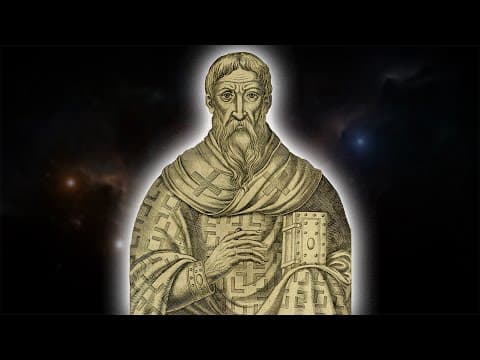
Pseudo-Dionysius, an influential yet enigmatic figure in Christian mysticism, is credited with shaping the concept of mysticism and integrating Neoplatonic philosophy into Christian theology. His writings, particularly on negative theology and the nature of God, have left a lasting impact on both Eastern and Western Christian thought, making him a pivotal figure in the history of mysticism.
The ancient Christian philosopher, theologian, and mystic known as Pseudo-Dionysius may not be a household name, but his influence on mysticism, philosophy, and esoteric thought is profound. He played a crucial role in shaping the concept of mysticism as we understand it today and was instrumental in the transmission of Neoplatonic philosophy into Christian theology. His works have significantly impacted both the Eastern Orthodox Church and Western traditions, influencing figures such as Thomas Aquinas.
The identity of Pseudo-Dionysius remains shrouded in mystery. He claims to be Dionysius the Areopagite, a judge in 1st-century Athens who converted to Christianity during Paul’s visit. However, scholars agree that the writings attributed to him were likely composed several centuries later by an anonymous author using this pseudonym. This practice of attributing works to authoritative figures was common in antiquity and was not necessarily considered forgery.
Despite the uncertainty surrounding his identity, Pseudo-Dionysius's writings reveal a deep familiarity with Neoplatonism, a philosophical system that evolved from the ideas of Plato. Neoplatonism posits a hierarchy of realities emanating from a singular source known as "the One." This metaphysical framework influenced Pseudo-Dionysius's understanding of God and the divine hierarchy.
Neoplatonism, particularly as articulated by Plotinus and later by Proclus, describes a reality consisting of various levels, with the One at the highest level. Below the One is the Nous (Mind), followed by the Soul, and finally the physical universe. Pseudo-Dionysius's thought aligns closely with this framework, particularly the Proclean interpretation, which emphasizes a structured hierarchy of existence.
Pseudo-Dionysius authored several significant works, including:
A central theme in Pseudo-Dionysius's writings is negative theology, or apophatic theology, which posits that God is beyond all human understanding and cannot be adequately described using positive attributes. Instead, knowledge of God comes through negation—by stating what God is not. This approach emphasizes the unknowability of the divine and aligns with the Neoplatonic view that the ultimate reality transcends all categories of thought.
Pseudo-Dionysius's exploration of the mystical union, or unio mystica, is a cornerstone of his philosophy. He argues that to approach God, one must detach from all worldly knowledge and concepts, entering a state of unknowing. This paradoxical journey leads to a deeper understanding of the divine, as one becomes united with the transcendent reality beyond all comprehension.
In his mystical theology, Pseudo-Dionysius employs the imagery of darkness to describe God. He suggests that God dwells in a darkness that surpasses light, emphasizing the limitations of human perception. This theme resonates with later Christian mystics, who also describe God in terms of unknowing and darkness.
The impact of Pseudo-Dionysius on Christian mysticism is profound. His writings laid the groundwork for later mystical traditions, influencing figures such as Meister Eckhart and the medieval mystics of the Rhineland. The term "mysticism" itself is believed to have been popularized through his work, particularly in the context of hidden interpretations of scripture and the sacraments.
Beyond theology, Pseudo-Dionysius's ideas have permeated art and architecture. His celestial hierarchy has influenced the design of churches and cathedrals, with the use of light and stained glass symbolizing the divine order he described.
In summary, Pseudo-Dionysius stands as a pivotal figure in the history of mysticism and Christian thought. His integration of Neoplatonic philosophy with Christian theology, along with his radical apophatic approach, has shaped the spiritual landscape for centuries. His works continue to inspire those seeking a deeper understanding of the divine and the mystical journey toward union with God.



















