
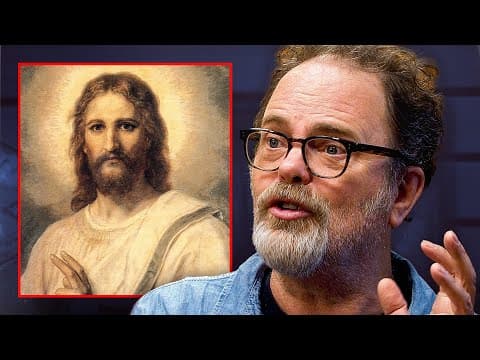
Rainn Wilson discusses the limitations of language in understanding God, the impact of translation on religious concepts, and the idea that our perceptions of God often reflect our own constructs rather than a true understanding of the divine. He emphasizes the importance of experiencing God beyond traditional notions and highlights the transformative power of music and nature in spiritual experiences.
In a thought-provoking conversation, Rainn Wilson explores the complexities of our understanding of God, emphasizing how our perceptions are often shaped by language, culture, and personal constructs. He critiques traditional debates about God's existence and encourages a deeper, more meaningful exploration of spirituality.
Wilson begins by referencing a Zen teaching that illustrates the limitations of language: "the finger that points at the moon is not the moon." This metaphor suggests that our words and thoughts about God are merely pointers, not the divine itself. He expresses a disdain for the fruitless debates often seen on platforms like YouTube, where individuals argue about the existence of God without engaging in deeper conversations about the nature of divinity.
Wilson quotes C.S. Lewis, who remarked that thoughts are like coins, warning against trusting the thin, worn images of God that we create in our minds. He argues that many people end up worshiping their own thoughts about God rather than the true essence of the divine. This idea resonates with the notion that our understanding of God is often limited by our language and cultural context.
The conversation shifts to the historical context of religious language and translation. Wilson highlights how translations can significantly alter our understanding of theological concepts. For instance, he discusses the term "sin," which originates from an ancient Greek word meaning "missing the mark." This perspective reframes sin not as a moral failing but as a natural human tendency to stray from our true path.
Wilson provides an intriguing example of how translation errors can lead to misconceptions in religious art. He mentions Michelangelo's statue of Moses, which depicts him with horns due to a mistranslation of the Hebrew word "ken." This misinterpretation has influenced how Moses is portrayed in art, illustrating how a single translation can alter our perception of a biblical figure and, by extension, our understanding of God.
The discussion delves into the nature of God, with Wilson referencing Abdul Baha from the Baha'i faith, who described Satan as the "insistent self." This interpretation suggests that the true struggle lies within us, as we grapple with our egos and desires. Wilson emphasizes that this internal conflict is a universal aspect of the human experience, transcending individual religious beliefs.
Wilson argues that God should be viewed more as an experience rather than a being with superpowers. He cites Thomas Aquinas, who believed that all religious language is analogical, meaning that our descriptions of God are inherently limited. Instead of viewing God as a powerful entity, Wilson suggests that God is closer to concepts like love, beauty, and music.
Reflecting on his own experiences, Wilson shares a profound moment he had at a Radiohead concert, where he felt a deep connection to the universe and a sense of divine presence. He argues that such experiences in nature or through art can be more spiritually fulfilling than traditional religious practices.
Rainn Wilson's insights challenge us to rethink our perceptions of God and spirituality. By recognizing the limitations of language, the impact of translation, and the importance of personal experience, we can move beyond outdated notions of divinity. Ultimately, Wilson encourages a more expansive understanding of God, one that embraces the beauty and complexity of existence itself.



















