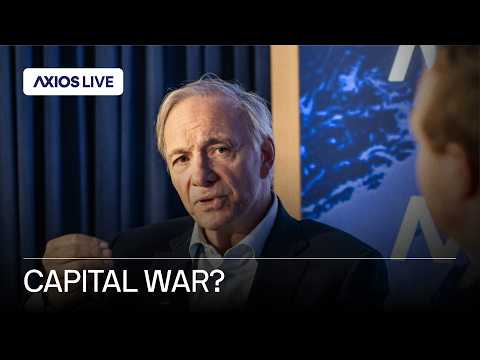
Ray Dalio discusses recent geopolitical tensions involving the US and Greenland, emphasizing the overlooked risk of capital wars alongside trade wars. He explains how shifts in monetary orders, geopolitical dynamics, and domestic politics are interconnected, highlighting central banks' moves away from fiat currencies toward gold as a reserve asset amid concerns about debt weaponization and currency stability.
Ray Dalio, founder of Bridgewater Associates and the Dalio Family Office, recently shared his perspectives on the evolving global economic and geopolitical landscape. His insights shed light on the complex interplay between trade tensions, capital flows, and the changing nature of monetary and geopolitical orders.
In recent days, President Trump threatened to impose significant tariffs on European countries over Greenland, a move that was later retracted despite preliminary agreements that did not include US ownership of Greenland. This episode sparked widespread commentary suggesting that market pressures constrained the president's actions.
Dalio explains that this incident is a microcosm of larger forces at play. He notes that the situation involved the potential for a trade war, which could have escalated into a capital war and even military conflict, highlighting the interconnectedness of trade, capital, and geopolitical dynamics.
As the threat of a trade war loomed, markets reacted with declines in stocks and bonds, while gold prices rose. Dalio emphasizes that gold should be viewed not merely as a speculative metal but as a form of money recognized by central banks as a reserve asset. This shift toward gold reflects concerns about the stability of fiat currencies and the broader monetary order.
While trade wars receive significant attention, Dalio stresses that capital wars—conflicts involving the control and weaponization of financial assets—are not discussed enough. Treasury Secretary Janet Yellen has downplayed the likelihood of countries selling US assets or weaponizing their holdings of US debt, but Dalio offers a more cautious view.
A capital war involves countries using their ownership of financial assets, such as government bonds, as leverage in geopolitical disputes. This can include selling off assets to destabilize another country's economy or refusing to honor debt obligations.
Dalio points out that central banks worldwide are adjusting their reserve compositions, reducing their holdings of fiat currencies like the US dollar and increasing their gold reserves. This diversification is driven by concerns over the reliability and value of fiat currencies, which are essentially debt instruments tied to the indebtedness of issuing countries.
History provides examples where holders of government bonds did not receive payments, such as Japanese bondholders before World War II and Russian bondholders in more recent times. These precedents fuel fears that debt instruments can be weaponized or defaulted upon during geopolitical conflicts.
Dalio highlights that the current monetary order is weakening and undergoing transformation. Simultaneously, geopolitical and domestic political orders are shifting, creating a complex environment that influences global markets and international relations.
Monetary orders define the systems and rules governing money, currency values, and reserves. As these orders change, so do the dynamics of trade, capital flows, and geopolitical power.
The evolving geopolitical landscape, marked by rising tensions and shifting alliances, interacts with domestic political changes within countries. These factors collectively drive the global economic environment and the potential for conflicts such as trade or capital wars.
Ray Dalio's analysis underscores the importance of looking beyond immediate trade disputes to understand the broader shifts in global monetary systems and geopolitical relations. The potential for capital wars, driven by concerns over debt, currency stability, and geopolitical rivalries, represents a significant risk that markets and policymakers must consider.
As central banks diversify reserves and countries navigate changing political landscapes, the interplay between trade, capital, and geopolitical orders will continue to shape the future of the global economy.