
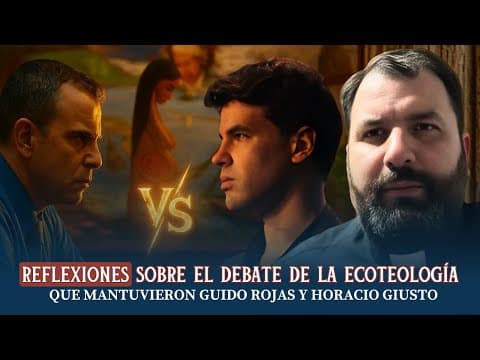
This blog post explores the recent debate on ecotheology between Guido Rojas and Horacio Giusto, highlighting key arguments, the role of the moderator, and the implications of ecotheology in relation to the Church's teachings and contemporary issues.
In a recent debate on ecotheology, Guido Rojas and Horacio Giusto engaged in a discussion that sparked significant interest and reflection. This post aims to summarize the key points of the debate, the attitudes displayed by both participants, and the broader implications of their arguments within the context of the Church's teachings.
The debate, moderated by a third party, showcased contrasting styles and approaches. Guido Rojas exhibited a passionate demeanor, which some perceived as overly emotional, while Horacio Giusto maintained a calm and reasoned stance throughout the discussion. The moderator noted that Guido's responses often lacked objectivity, which led to a heated exchange rather than a constructive dialogue.
Following the debate, Guido publicly apologized to Horacio for his conduct, acknowledging that the intensity of the discussion may have clouded his judgment. This gesture was seen as a positive step towards mending any rifts caused by the debate's heated moments.
One of the central questions raised during the debate was whether ecotheology is functional to the so-called New World Order. The moderator posed a critical question: how can ecotheology, which upholds the sanctity of life and opposes ideologies such as abortion and gender theory, align with a movement that promotes these very concepts?
Horacio defended the position that ecotheology, as promoted by the Catholic Church, is fundamentally opposed to these ideologies. He emphasized that the Church's teachings prioritize human dignity and the moral responsibility to care for creation without compromising ethical standards.
The moderator's role was to maintain neutrality while ensuring that both participants had equal opportunities to present their arguments. He faced criticism for allowing certain fallacies to go unaddressed during the debate, but he argued that interrupting the flow of conversation would have hindered the audience's ability to hear both sides.
A significant point of contention was the distinction between what constitutes Church magisterium and personal opinion. Horacio argued that while the Pope's statements on climate change are scientifically grounded, they do not fall under the infallible teachings of the Church. The moderator countered that the consistent emphasis on ecological responsibility across multiple papacies indicates a doctrinal commitment that should not be dismissed.
The moderator shared his personal experience with papal encyclicals, admitting that while he reads them, he often finds them lacking in new insights. He expressed that his understanding of ecological responsibility does not solely rely on these documents, suggesting that individual interpretation and engagement with the teachings can vary significantly among clergy and laity.
The debate also touched on the complexities surrounding environmental issues, such as mining practices. The moderator pointed out that legality and ethical considerations are crucial in evaluating environmental practices. He emphasized that discussions should focus on whether practices are legal and environmentally sustainable rather than solely on their method of execution.
The debate between Guido Rojas and Horacio Giusto highlighted the need for constructive dialogue within the Church regarding ecotheology and environmental ethics. Both participants brought valuable perspectives to the table, and their exchange serves as a reminder of the importance of respectful discourse in addressing complex issues. As the Church continues to navigate these discussions, it is essential to uphold the dignity of all individuals while striving for a deeper understanding of ecological responsibility.
The moderator concluded by reflecting on the polarization within the Church, urging for unity and constructive criticism rather than division. The debate serves as a call to action for all members of the Church to engage thoughtfully with contemporary issues while remaining grounded in the core teachings of the faith.



















