
Reforestation is a complex process that involves understanding forest succession, exploring various regeneration methods, and recognizing the importance of natural processes. While planting trees is essential, allowing nature to regenerate and using assisted natural regeneration can be equally effective in restoring ecosystems and absorbing carbon.
These four square kilometers in western Arkansas used to be a cattle ranch. But today, they’re home to more than 300,000 freshly planted trees. Makeovers like this one are a promising tool to address Earth’s climate crisis. Our planet could absorb a significant amount of the heat-trapping carbon we’ve been pumping into the atmosphere if we could just put it into trees. However, rebuilding a healthy forest is much more complex than simply scattering some acorns and hoping for the best.
Researchers have identified restoring forests around the globe as a major player in absorbing atmospheric carbon. This means that while we need to explore various avenues to combat the climate crisis, we can make substantial progress just by planting trees. Scientist Pat Brown, known for creating the Impossible Burger, is now focusing on how to transform land cleared for cow pastures back into forests that can absorb maximum carbon.
The challenge with regrowing forests is that there is no one-size-fits-all method. When a forest forms naturally, it undergoes different stages of development known as forest succession. This process begins with small plants emerging from seeds, followed by larger plants that alter the soil and create shade, eventually leading to a stable and mature forest canopy. This natural progression unfolds slowly, often taking decades or even centuries, during which various plant and animal species gradually come and go.
To expedite forest regeneration, scientists like Pat Brown are researching three different approaches to create a replicable system. They are investigating whether to let nature take its course or provide assistance, and if so, what kind of help is needed.
Passive Regeneration: In one section of land, the team is allowing the area to grow wild without intervention. This method relies on natural processes to restore the ecosystem.
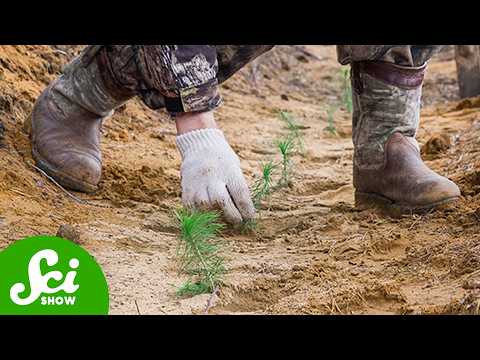
Active Regeneration: On two other sections, the team is actively planting new forests. One section features around 30 different species of native trees to kickstart a diverse forest. While this method aims to restore the ecosystem, it is still not particularly fast, and the results remain uncertain.
Fast-Growing Timber Species: In the final section, the team planted timber species known for rapid growth. Although this approach may not restore the original ecosystem, it is cost-effective and can quickly produce large trees that absorb significant amounts of carbon. The hope is that creating a shaded environment will facilitate the growth of native species.
Each active regeneration method has its advantages and disadvantages, particularly regarding the time and resources required to plant a forest from scratch. Raising trees in nurseries for a few years and then planting them individually can be impractical.
Interestingly, some scientists argue that simply leaving the land alone may be the best approach to regrowing forests. Nature often returns to areas left undisturbed, regardless of previous damage. For example, the abandoned city of Pripyat, decades after the Chernobyl disaster, is now dotted with healthy, mature trees. Similarly, Puerto Rico, which saw a drastic reduction in forest cover in the late 1940s, has rebounded significantly since the 1950s when farming declined.
This phenomenon, known as natural regeneration, is cost-effective since it requires minimal intervention. However, the downside is that these re-wilded forests may not perfectly replicate the original ecosystems, and it can take a long time for species to return to their original numbers.
Some studies suggest that natural regeneration can outperform active regeneration in certain forest types, particularly tropical forests. The challenge lies in determining when and where natural regeneration is most effective, as some areas may be trapped in a human-induced feedback loop that prevents recovery.
To address situations where natural regeneration is insufficient, conservationists have explored a middle ground known as assisted natural regeneration. This approach involves helping the land recover without fully planting the forest. Various methods can be employed, such as:
While there is no definitive playbook for restoring forests to absorb the vast amounts of carbon humans have added to the atmosphere, the good news is that multiple strategies exist. Continued research, like that conducted by Pat Brown in Arkansas, is essential to identify the best methods for each ecosystem, whether through planting trees or allowing nature to take its course. Our challenge is to understand what hinders natural recovery in each location and how we can assist in the process. The sooner we can save forests, the sooner they can help save us from the climate crisis.



















