
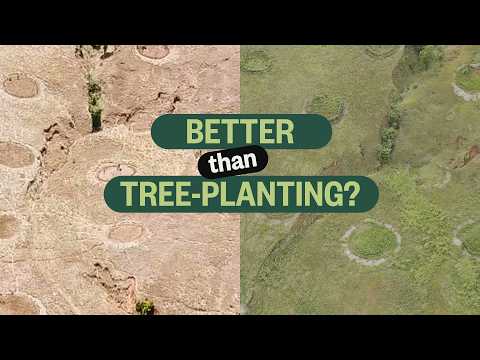
Madagascar is employing an innovative technique called foxholes to restore ancient forests without planting trees. This method enhances plant diversity and growth rates while engaging local communities in conservation efforts.
In a groundbreaking approach to ecological restoration, Madagascar is utilizing a technique known as foxholes to revive ancient forests without planting a single tree. This method not only fosters forest-like conditions but also significantly increases tree density and plant diversity compared to traditional tree planting methods.
Foxholes are shallow pits dug into the ground where seeds of multiple tree species are sown. This technique encourages competition among the seeds for light, water, and nutrients, leading to healthier and faster growth. The name "foxholes" is inspired by a wartime strategy of digging shallow holes for protection, which is fitting given the frequent wildfires in the region.
The project team, including experts from Ecosia and Phoenix Conservancy, traveled from Antananrivo, the capital of Madagascar, to Ivohiboro, a remote area in the southeastern part of the island. This journey, filled with unexpected delays, highlighted the challenges of accessing remote conservation sites. Upon arrival, the team was greeted by the unique biodiversity of Ivohiboro, which is home to several endangered species, including four lemur species and plants found nowhere else on Earth.
Madagascar faces a severe ecological crisis, with nearly 90% of its forests lost, leading to a potential collapse of its ecosystems. The Ivohiboro forest is particularly crucial as it serves as a vital water source for the surrounding communities and is a remnant of the island's once-thriving rainforest.
Foxholes are spaced approximately 15 to 30 meters apart, creating clusters of forest rather than a uniform planting. This method mimics natural forest succession, where ecosystems rebuild themselves after disturbances. Initially, nitrogen-fixing plants like pigeon peas are planted to enrich the soil, followed by pioneer species that thrive in harsh conditions. After a few years, enrichment species are introduced, creating a layered forest structure similar to natural forests.
The foxhole technique has shown remarkable results:
A critical aspect of the foxhole project is the involvement of local communities. The restoration efforts are designed to provide jobs and create a sustainable local economy. By hiring local workers to build foxholes and plant seeds, the project not only restores the ecosystem but also supports livelihoods.
One innovative approach is the cultivation of marula trees, which produce oil that can be sold in local and international markets. This initiative aims to create a self-sustaining economy that incentivizes the protection of forests rather than their destruction.
While the foxhole technique shows great promise, challenges remain. The primary concern is ensuring the long-term survival of the trees against threats such as wildfires and illegal logging. To address this, firebreaks are established around the foxholes, and community education is emphasized to reduce the incidence of fires set for agricultural purposes.
The foxhole technique represents a revolutionary step in forest restoration, demonstrating that innovative methods can yield significant ecological benefits while engaging local communities. As the project progresses, it serves as a model for similar initiatives worldwide, emphasizing the importance of collaboration and sustainable practices in environmental conservation. The success of foxholes in Madagascar could inspire global efforts to restore degraded landscapes and combat climate change, proving that it is never too late to make a difference.



















