
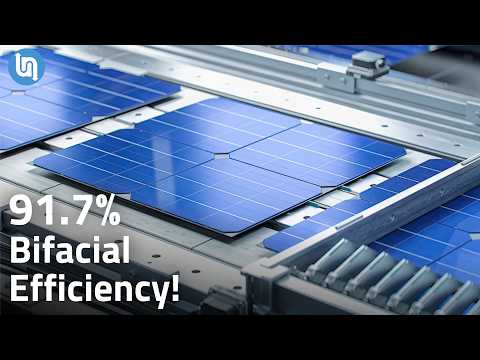
Tongwei's bifacial solar panels are achieving remarkable efficiency levels, with the back side performing at 91.7% of the front. This breakthrough utilizes TOPCon technology, allowing for significant power gains without the high costs associated with traditional methods. The panels leverage albedo effects and innovative design to maximize energy capture, making them a promising option for urban solar installations.
What if I told you there's a way to get up to 30% more power from the same solar panel footprint? No breakthrough chemistry or quantum physics is needed—just one simple change that’s finally starting to catch on: solar cells on both sides of the panel. Tongwei has achieved something remarkable with their bifacial solar panels, reporting an efficiency of 91.7% on the back side compared to the front. This is significant news, especially since it has been accomplished using cheaper technology that was previously considered inferior.
Before diving into the specifics of Tongwei's innovation, it's essential to understand what solar panel efficiency means. Solar cell efficiency measures how much usable energy a panel can extract from sunlight. The current average efficiency for commercial solar cells is around 22%. However, bifaciality measures how well the backside of a solar panel performs compared to the front. The 91.7% bifaciality figure is what makes Tongwei's achievement revolutionary.
Bifacial photovoltaic (PV) panels operate similarly to traditional monofacial panels. Each solar cell consists of a silicon semiconductor core, and the process of energy conversion involves photons knocking electrons loose from silicon bonds, creating positively charged holes. An electric field within the cell directs these electrons and holes to different contacts, preventing them from recombining and losing energy as heat.
A common misconception is that the backside of bifacial panels would be ineffective since it faces away from the sun. However, this is mitigated by a phenomenon known as albedo, which measures how much light bounces off surfaces. Many everyday materials, such as snow, sand, and certain roofs, have high albedo values. This reflected light can be captured by the backside of bifacial panels, allowing them to generate energy even in diffuse light conditions, such as on cloudy days or in urban environments.
Tongwei's bifacial panels utilize three key elements: TOPCon solar cells, inverse-pyramid architecture, and zebra crossing passivation contact layers.
TOPCon stands for tunnel oxide passivated contact solar cells. This technology is known for its stability and high photovoltaic efficiency. The effectiveness of TOPCon cells, particularly bifacial ones, relies heavily on the passivation provided by the silicon oxide layer. While the market has been dominated by PERC cells, which typically achieve around 70% bifaciality, TOPCon cells can reach 80-85%. In contrast, Heterojunction Solar Cells (HJT) can achieve 92-95% bifaciality but at a much higher manufacturing cost.
The unique design of the solar cells features sunken pyramids on the back, which act as electron sinkholes. This design allows photons to bounce around within the cell, increasing the likelihood of absorption rather than reflection.
The zebra crossing passivation involves a laser-sintering process that creates alternating patterns of passivation layers on the pyramids. This innovative approach enhances the efficiency of electron collection, allowing for better performance overall.
While bifacial solar panels offer significant advantages, they also come with higher costs. Generally, bifacial panels are 10-20% more expensive to install than traditional monofacial panels. The complexity of installation increases as both sides of the panel must be accounted for, which can lead to longer payback periods for homeowners.
Bifacial panels can also present maintenance challenges, as dirt and debris can accumulate between the panel and the ground, potentially affecting performance. Additionally, retrofitting existing solar systems to accommodate bifacial panels may require new mounting brackets and installation methods, adding to the overall cost.
The 91.7% efficiency figure is based on lab conditions, and real-world performance may yield more modest gains. However, installations typically see an increase of 10-20% in power output from bifacial panels compared to monofacial ones. The exact gains depend on the installation environment; for instance, panels installed over white commercial rooftops can achieve 15-20% more power, while fresh snow can push gains up to 30%.
Tongwei's achievement of 91.7% bifaciality using cost-effective TOPCon technology represents a significant advancement in solar energy. This breakthrough not only closes the performance gap with more expensive technologies but also enhances the overall efficiency of solar panels. As the technology matures and costs decrease, bifacial solar panels are likely to become more prevalent in urban settings, where maximizing energy capture is crucial.
The outlook for bifacial PV technology is promising, with ongoing developments in the field. As more companies enter the market and innovations continue to emerge, the future of solar energy looks bright. Are bifacial solar panels the next big thing in renewable energy, or just another trend? Only time will tell, but the potential for increased efficiency and reduced costs makes them a compelling option for the future of solar power.



















