
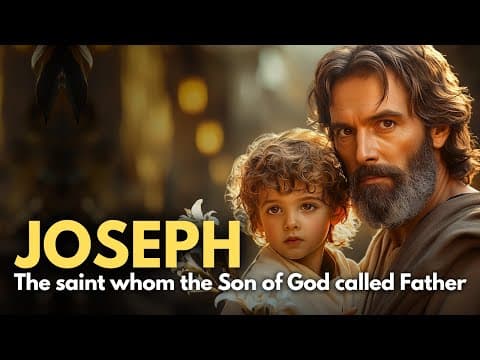
Saint Joseph, the earthly guardian of Jesus and spouse of Mary, is a model of silence, obedience, and self-giving. His life exemplifies the virtues of faith, fatherhood, and work, making him a revered figure in the Catholic Church and a patron for families and workers alike.
Have you ever wondered how a man who did not utter a single word in scripture could become one of the most venerated Saints of the Catholic Church? Saint Joseph, the humble carpenter of Nazareth, emerges in the history of Salvation as a silent giant of faith, obedience, and self-giving. What extraordinary virtue did this righteous man hide to deserve being the earthly guardian of the Son of the Most High and the virginal spouse of the Immaculate Mary? Let us contemplate together the mystery of this extraordinarily ordinary life, which, without speeches or spectacular wonders, reached the heights of sanctity through eloquent silence and sacrificial love.
Saint Joseph is an enigmatic and profound figure who remains a silent guardian in the Gospel accounts. His impact on the history of Salvation is immeasurable, as not a single word of his was recorded in the sacred texts. However, his actions resonate through the centuries as a living testimony of faith, obedience, and complete surrender to the Divine will. Joseph's silence was not an absence of communication but the fullness of contemplation in a world saturated with noise and empty words.
Pope Benedict XVI noted that the silence of Saint Joseph does not manifest an inner void but the fullness of faith he carries in his heart, guiding each of his thoughts and actions. The Church Fathers marveled at this eloquent silence, with St. John Chrysostom commenting that even without uttering a word, Joseph spoke through his deeds. This quiet man reveals that genuine spiritual greatness is not found in elaborate speeches but in the consistency between one's faith and life.
Divine Providence chose Joseph, a descendant of the House of David, for an unprecedented marriage in human history. When the young carpenter of Nazareth betrothed Mary, he could not imagine the sublime mystery in which he would participate. The Gospel According to St. Matthew reveals the inner drama Joseph experienced upon discovering that his betrothed had conceived before they came to live together. His righteousness manifested in his decision to quietly divorce her to avoid exposing her to public disgrace.
Divine intervention transformed confusion into sacred mission when the angel communicated to him in a dream, urging him to take Mary as his wife. The marriage between Joseph and Mary is a perfect model of conjugal union, consecrated by a love deeper than any carnal bond. The Church Fathers admired this unique relationship where perfect purity and chastity coexisted with tender conjugal affection.
Upon awakening from that revelatory dream, Joseph was no longer the same. The Heavenly messenger had indicated that he would raise the Son of God, legally incorporating Him into the house of David and fulfilling Messianic prophecies. Joseph's fatherhood, although not biological, was fully real in every aspect that truly matters. In the Nazareth workshop, Joseph's hands guided the tiny hands of the Creator of the universe, teaching Him the noble trade of carpentry.
Joseph modeled for the Incarnate Son of God the true face of human fatherhood. The Gospels attest to how the neighbors of Nazareth referred to Jesus as "the carpenter's son," highlighting the paternal authority Joseph exercised with humility and love over the one who was his God.
On December 8th, 1870, amid turbulent times for the Church, Blessed Pope Pius IX solemnly proclaimed Saint Joseph as the patron of The Universal Church. This declaration was not merely a devotional act but the official recognition of a profound truth: he who guarded the physical Christ in His earthly life continues to protect His mystical body through the centuries.
The analogy between the Holy Family and The Universal Church finds in Saint Joseph a privileged point of connection. Just as Joseph diligently cared for the Holy Family, he now defends and protects the Church of Christ with his Heavenly patronage. The title of patron of The Universal Church gains special resonance when we consider the universality of Joseph's figure, making him accessible to all cultures and human conditions.
Joseph's life was directed toward fulfilling God's will without delay or questioning. He received Divine messages through dreams, and on each occasion, his response was immediate and complete obedience. This phrase, repeated in the Gospel According to St. Matthew, reveals the spiritual essence of the Holy Carpenter.
His obedience was not blind submission but a mature response cultivated through a refined spiritual ear to discern the Divine will. The Church Fathers saw in Joseph's obedience a direct contrast to Adam's disobedience, highlighting his perfect inner attunement with the Divine will.
The calloused hands of the carpenter of Nazareth shaped more than mere pieces of wood; they formed the human character of the Son of God and elevated manual work to unprecedented dignity. Pope Pius XII, when instituting the Feast of St. Joseph the Worker, wished to offer the world's workers a celestial patron who truly understood the dignity and hardships of daily work.
Joseph teaches us that human work, when performed before God's eyes and out of love for one's family, becomes a path of sanctification and service to others. His silent diligence reminds us that the value of work is not measured primarily by social recognition or economic remuneration but by the love and integrity with which it is done.
Under the humble roof of Nazareth, Joseph watched over the two most precious treasures of Heaven: the Incarnate Word and the Immaculate Virgin. This custody was his primary mission, the very reason for his existence in God's Plan of Salvation. Joseph's protection was not merely physical; he also created an environment conducive to the development of Jesus's Redemptive Mission.
His paternal authority provided the necessary framework for the divine plan to unfold according to the human rhythms of growth and maturation. Joseph's courage and determination were evident when he fled to Egypt to protect the child from Herod's threat.
The litanies to Saint Joseph include the title "Terror of Demons," recognizing the profound spiritual reality that Joseph's presence signified in the Plan of Redemption. His humility was an impregnable fortress against the snares of the enemy. His silence, full of contemplative wisdom, stood in stark contrast to the confused clamor of evil.
Numerous Saints and Mystics have testified to the power of Saint Joseph against demonic assaults. His purity of life serves as a powerful antidote against the deceits of the malignant one, offering an inspiring model for those struggling to live virtuously in a world saturated with incitements to impurity.
Catholic tradition presents Saint Joseph as peacefully departing in the arms of Jesus and Mary. Although the Gospels are silent about the circumstances of his death, his absence during Jesus' public ministry suggests he parted for the Father's house before the Savior began His preaching.
The title of Patron of a Good Death is founded on Joseph's unique position in the history of Salvation. His closeness to the mysteries of the Incarnation and Redemption makes him a sure guide for the final journey. Traditional iconography often depicts Joseph's departure surrounded by Jesus and Mary, inspiring countless Christians to invoke his intercession in the face of death.
The virginal marriage of Joseph and Mary constitutes one of the most sublime mysteries of the economy of Salvation. Chosen to be the spouse of the ever-virgin Mary, Joseph embraced perfect chastity as a loving response to the divine plan. The Church Fathers admire this unique union where true conjugal love coexisted with perpetual virginity.
In a world where chastity is often undervalued, the figure of Saint Joseph emerges as a countercultural testimony to the beauty and dignity of this virtue. His example teaches that chastity, lived according to one's state of life, is a positive orientation of the loving impulse toward its highest expressions.
The home of Nazareth under Joseph's paternal guidance stands as the timeless archetype of every Christian family. Joseph exercised his authority not as domination but as an act of loving service. His family leadership was imbued with humility, turning everyday tasks into expressions of selfless love.
Pope Francis highlights that Joseph was a father in welcoming, encouraging, and exercising a fatherhood centered on service and self-donation. The order and harmony that reigned in the Nazareth home provide an enduring lesson for families of all times.
Oh glorious Saint Joseph, most faithful custodian of Heaven's treasures, to you we turn with filial confidence, knowing that your paternal heart never remains indifferent to the pleas of those who invoke you. Extend now your protective mantle over us amid life's storms. Teach us, silent and just father, to listen as you do to the voice of God in the quiet of prayer.
May we learn from your example to respond with promptness and faithfulness to Divine inspirations, recognizing in every event a call to trust in the Providence that never abandons its children. Patron of The Universal Church, protect the mystical Body of Christ from the perils that beset it. Uphold Christian families, so they may find in the Nazareth home an inspiring model of love, sacrifice, and fidelity.
Mighty intercessor before God's throne, present our material and spiritual needs to Him who grants all things. Help those who suffer economic hardship, console the sick, and assist us as patron of a good death. May we depart peacefully in the arms of Jesus and Mary, just as you were graced to do. Amen.



















