
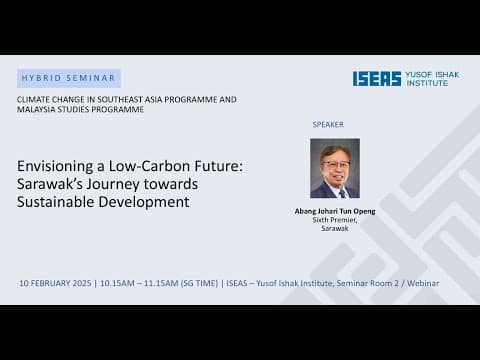
The seminar on Sarawak's journey towards sustainable development highlighted the region's commitment to a low-carbon future through innovative strategies, renewable energy initiatives, and collaborative efforts with neighboring countries. Premier Tan Sri Abang Johari emphasized the importance of balancing economic growth with environmental responsibility, showcasing Sarawak's ambitious Post-COVID Development Strategy 2030 and various renewable energy projects.
Today, we had the honor of hosting a seminar featuring the Right Honorable Tan Sri Abang Johari, the Premier of Sarawak, who delivered a lecture on Sarawak's vision and strategic initiatives for a low-carbon future. The event was moderated by Mr. Cho Shin, Director and CEO of the ISIS YF ISA Institute. This blog post summarizes the key points discussed during the seminar, focusing on Sarawak's commitment to sustainable development and climate action.
The seminar opened with a discussion on the current state of global climate action. Premier Abang Johari noted that climate solidarity is faltering, with developing countries expressing disappointment over the climate finance goals set at COP 29. He emphasized that despite these challenges, the urgency of climate action cannot be overstated. Subnational climate action, particularly from states and provinces, is crucial as they often have the resources and local knowledge necessary to implement innovative solutions.
Sarawak stands out as a leader in subnational climate action within Southeast Asia. The region has a wealth of natural resources and a strong commitment to sustainability. In response to the COVID-19 pandemic, Sarawak unveiled its ambitious Post-COVID Development Strategy 2030 (PCDS 2030), which prioritizes green growth, social equity, and environmental sustainability. This strategy aims to ensure equitable access to education, healthcare, and digital connectivity while promoting clean energy, sustainable land use, and reforestation efforts.
Sarawak aims to become a regional renewable energy powerhouse, particularly through its hydropower initiatives. The state plans to quadruple its renewable energy generation capacity to 15 gigawatts by 2035. Notably, Sarawak is collaborating with Singapore on a groundbreaking subsea cable project to supply 1 gigawatt of renewable energy, with commercial operations expected to commence in 2031. Additionally, Sarawak is exploring opportunities in hydrogen production, carbon capture utilization and storage (CCUS), and biomass sustainable fuel.
Sarawak's commitment to environmental stewardship is evident in its policies on reforestation and sustainable agriculture. The state aims to balance economic development with environmental conservation, setting an example for others to follow. The PCDS 2030 serves as a roadmap for achieving prosperity, inclusivity, and environmental sustainability by 2030.
To reinforce its commitment to sustainability, Sarawak has introduced several key policy reforms, including the Land Carbon Storage Rules 2022 and the Greenhouse Gas Emission Ordinance 2023. These policies mandate greenhouse gas reporting and support carbon markets, ensuring that sustainability remains central to development. The implementation of these policies is crucial for accelerating industrial decarbonization and advancing green innovation.
Sarawak's journey towards sustainable growth extends beyond energy. The state is also focusing on urban development and digital transformation to create efficient, connected, and green cities. Initiatives such as Southeast Asia's first hydrogen-powered autonomous rapid transit system and the Sarawak Digital Economy Blueprint 2030 aim to improve energy use, waste management, and urban planning.
Global collaboration is essential for Sarawak's sustainability efforts. The state is engaging with international stakeholders to expand its low-carbon industries and develop sustainable infrastructure. The establishment of the Sarawak Climate Change Center will serve as a regional hub for research, policy development, and collaboration on climate change adaptation and mitigation.
In conclusion, Sarawak's journey towards a low-carbon future is marked by a strong commitment to sustainability, innovative policies, and collaborative efforts with regional and global partners. Premier Abang Johari's vision reflects the belief that economic growth and environmental responsibility can progress together. As Sarawak moves towards 2030, it aims to foster sustainability through innovation, investment, and strategic incentives in renewable energy and green technologies. The seminar provided valuable insights into how Sarawak is addressing the challenges of climate change while ensuring a prosperous future for its people.



















