
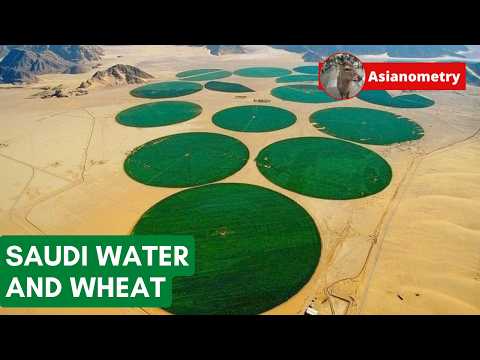
Saudi Arabia's quest for food self-sufficiency, particularly in wheat, has led to significant agricultural growth but at a high environmental cost. The reliance on fossil aquifers for irrigation has raised sustainability concerns, prompting a reevaluation of agricultural policies in the face of dwindling water resources and changing geopolitical landscapes.
Saudi Arabia has long recognized its vulnerability in food security, prompting a bold initiative in 1980 to achieve self-sufficiency in food production, primarily focusing on wheat. This ambitious program, fueled by oil revenues and groundwater resources, has had profound implications for the nation’s agricultural landscape and water sustainability.
In 1970, Saudi Arabia's population was approximately 5.8 million, with over half of its food being imported. The government began subsidizing food imports in 1959 to maintain affordability and prevent social unrest. However, rapid population growth, which exceeded 3.5% annually, compounded the food dependency issue. By 1992, the population had surged to 16.4 million, increasing the demand for more diverse and expensive food products, such as meat and dairy, further straining the import system.
Reliance on food imports exposes a country to various risks, including fluctuations in global food production and prices. Historical events, such as the rice crisis of 2007/2008 and the oil embargoes of the 1970s, highlighted the vulnerabilities of nations dependent on external food supplies. The Saudi leadership recognized that food could be wielded as a political weapon, prompting a shift towards self-sufficiency.
Saudi Arabia is one of the most arid countries globally, receiving only 50 to 100 millimeters of rain annually, primarily between November and April. Less than 2% of its land is arable, and even that is underutilized due to inadequate water resources and infrastructure. The Asir mountains in the southwest represent the most significant agricultural area, benefiting from more regular rainfall and supporting crops like dates and grains.
Beneath the arid landscape lies a vast network of fossil aquifers, formed tens of thousands of years ago during wetter climatic periods. These aquifers, while substantial, are non-renewable and do not recharge easily. The extraction of groundwater for agriculture has been extensive, raising concerns about long-term sustainability.
Historically, Saudi society relied on groundwater and traditional farming methods, with many people living off the land through a network of dry riverbeds known as "wadi." The government attempted to modernize agriculture in the 1960s by distributing fallow lands to encourage sedentary farming, but progress was slow.
The First Five-Year Development Plan in 1970 aimed for a 4.6% growth in agriculture, but actual growth fell short. The Second Development Plan (1975-1980) saw a dramatic increase in funding, focusing on infrastructure and agricultural subsidies. The Third Plan marked a significant shift towards food self-sufficiency, with substantial financial incentives for farmers.
By the mid-1980s, Saudi Arabia achieved wheat self-sufficiency, producing a surplus and even exporting wheat to neighboring countries. The government guaranteed high prices for locally grown wheat, which led to a rapid increase in production. However, this success came at a significant financial cost, with estimates of over $18 billion invested in the wheat program.
Despite the apparent success, critics pointed out several issues. The program was costly, and the focus on wheat neglected other essential food products. By 1981, Saudi Arabia still imported 90% of its food, including significant quantities of meat and vegetables. Furthermore, many wheat farms were owned by foreign investors, raising questions about local expertise and technology transfer.
The most pressing concern was the unsustainable use of groundwater. Between 1980 and 1984, agricultural water use skyrocketed, with over 70% of the water for wheat coming from non-renewable aquifers. Despite achieving self-sufficiency, the government continued its wheat purchasing policies, treating wheat as a strategic commodity akin to oil.
The 1990s brought a reevaluation of agricultural policies due to concerns over water sustainability and changing economic conditions. The First Gulf War strained government finances, and by 1991, agricultural water demand had surged to unprecedented levels. The government began to cut subsidies and adjust policies, leading to a decline in wheat production.
By the mid-1990s, Saudi Arabia's wheat production fell significantly, and the country became reliant on imports once again. The government phased out wheat subsidies, and while other food production continued, the reliance on non-renewable groundwater persisted.
The depletion of aquifers has led to land subsidence and increased salinity in remaining water supplies. As groundwater resources dwindle, the challenge remains to balance agricultural needs with urban water demands. The reliance on desalination, while growing, has not yet fully compensated for the loss of groundwater.
While the pursuit of food self-sufficiency is commendable, Saudi Arabia's experience highlights the complexities of balancing agricultural ambitions with environmental realities. The recent geopolitical disruptions, such as the war in Ukraine, have reignited discussions on food security. Moving forward, a combination of sustainable practices, including increased desalination and water conservation, may provide a more balanced approach to food production in the arid landscape of Saudi Arabia. The lessons learned from the past should guide future policies to avoid repeating the mistakes of the wheat self-sufficiency program.



















