
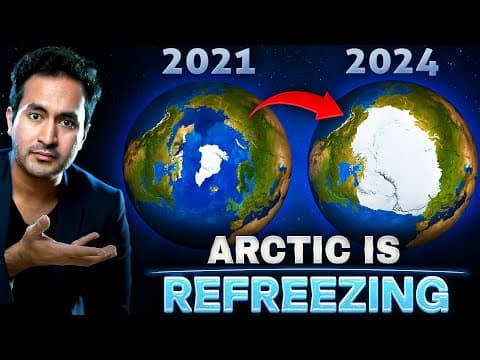
A Dutch startup, Arctic Reflections, is initiating a massive project to refreeze Arctic sea ice using saltwater, aiming to combat global warming and its catastrophic effects on coastal cities worldwide.
The Arctic region has been undergoing drastic changes over the past few decades, with satellite data from NASA revealing alarming rates of ice melt. Comparing images from September 1984 and September 2019, we see that the North Pole's ice is disappearing at an unprecedented rate of approximately 12.2 percent every decade. In response to this crisis, a Dutch startup named Arctic Reflections is launching a mega project aimed at refreezing the Arctic sea ice, a task as ambitious as colonizing Mars.
Arctic Reflections plans to cover an area of 15.5 million square kilometers, equivalent to five times the size of India, with a deadline of just six years. The method involves spraying saltwater over the existing ice, a technique that may seem counterintuitive but is based on traditional practices used in cold regions to prevent ice formation on roads. The scientists believe that by using saltwater, they can create a new layer of ice that will help combat the ongoing melting.
The urgency of this project is underscored by recent estimates suggesting that by September 2030, we may witness the first summer where Arctic sea ice completely melts. NASA scientist Christina Pistone warns that if this occurs, the subsequent rise in carbon dioxide emissions will lead to a rapid increase in global temperatures post-2030. The summer of 2023 has already seen record-breaking heat, with temperatures soaring to 50 degrees Celsius in parts of India, resulting in thousands of hospitalizations and fatalities.
The melting of Arctic ice is not just an environmental issue; it poses a direct threat to coastal cities worldwide. Cities like Jakarta, Bangkok, and even Mumbai are experiencing rising sea levels, leading to flooding and displacement. The complete melting of Arctic sea ice could result in the disappearance of several coastal cities, making the preservation of this ice a critical issue for humanity's survival.
To tackle this monumental challenge, Arctic Reflections has devised a strategy that minimizes costs and maximizes efficiency. They have chosen the Svalbard archipelago in Norway, one of the fastest-warming places on Earth, as their testing ground. Using small diesel-powered water pumps, they will spray saltwater from the Arctic Ocean onto the ice. This saltwater, when exposed to the cold air, will freeze and create an additional layer of ice.
The use of saltwater is crucial because it freezes at a lower temperature than freshwater. While freshwater freezes at 0 degrees Celsius, saltwater can freeze at around -20 degrees Celsius. This means that in the frigid Arctic temperatures, both types of water will freeze, allowing the saltwater to effectively contribute to the formation of new ice without accelerating melting.
Despite the innovative approach, Arctic Reflections faces skepticism and criticism. Some argue that the project is unnecessary hype or downplay the threats posed by global warming. However, the scientific consensus indicates that human activities, particularly since the industrial revolution, have significantly contributed to rising global temperatures. The average global temperature has increased from 13.7 degrees Celsius in 1850 to 15.8 degrees Celsius today, with a notable acceleration in warming since the 1980s.
The consequences of global warming extend beyond just rising temperatures. The melting of polar ice caps triggers a cascade of events that further exacerbate climate change. As ice melts, less sunlight is reflected back into space, leading to increased ocean evaporation and the release of greenhouse gases like methane. This creates a feedback loop that accelerates warming and leads to more extreme weather events.
The initiative by Arctic Reflections represents a critical step in the fight against global warming. By attempting to refreeze the Arctic ice, scientists hope to mitigate the catastrophic effects of climate change on coastal cities and the planet as a whole. As we face an increasingly urgent climate crisis, innovative solutions like this may be our best hope for preserving our planet for future generations.
In the face of skepticism, it is essential to recognize the scientific evidence supporting the reality of global warming and the need for immediate action. The fate of our planet may depend on the success of projects like Arctic Reflections, making it imperative for us to support and advocate for such initiatives.



















