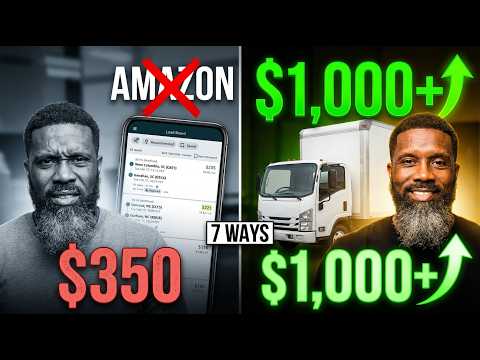
Many box truck owners depend heavily on Amazon Relay for income, but this reliance can be risky. This article explores seven alternative, stable, and profitable ways to generate $1,000 to $5,000+ weekly using a box truck. From local furniture contracts to direct shipper relationships, these strategies emphasize building lasting business relationships and leveraging your truck as an asset rather than chasing loads.
If you own a box truck and rely solely on Amazon Relay for income, you might be vulnerable to sudden changes like account shutdowns, rate drops, or lack of available routes. This article is inspired by Marcus, a box truck owner who thought he had it all figured out with Amazon Relay but soon realized the importance of diversifying his income streams.
Marcus worked a 9-to-5 job, saved money, formed an LLC, built credit, and bought a box truck. His plan was simple: as long as he could log into Amazon Relay, he was good. However, one week, no good routes appeared, rates dropped, and his account was flagged. Suddenly, he found himself anxiously refreshing his phone at 6 a.m., hoping for work like it was a job interview.
This scenario is common among many box truck owners who depend on a single platform. The key takeaway is that owning a truck is about leverage, not just chasing loads.
Before diving into the seven ways to make money, it’s crucial to highlight the importance of having the right insurance coverage. One accident without proper insurance can wipe out everything you’ve built. New authorities should ensure their insurance is structured correctly to protect their business foundation.
Marcus lives in a midsize city with six furniture stores and two warehouse liquidation spots within 15 miles. By walking into one store and landing a contract for 10 deliveries per day at $100 per stop, he could gross $1,000 daily. Working four days a week, that’s $4,000 gross weekly.
Expenses include paying a crew $450 per day and fuel costs of $150 per day, totaling $600 daily expenses. This leaves a net of $400 per day or $1,600 weekly net. This is significantly better than chasing small Amazon routes.
Marcus contacts a regional medical supplier needing daily hospital drop-offs with scheduled routes and consistent drivers. They offer $900 per day, five days a week, totaling $4,500 gross weekly.
Fuel costs $250 per day, totaling $1,250 weekly. After paying a driver $1,100 weekly, Marcus nets around $2,000 weekly. Medical supply routes are stable and recurring, providing predictable income even when freight slows down.
By registering as a local vendor, Marcus secures a $12,000 contract from a school district to move equipment before the semester over 10 working days. This equates to $1,200 gross per day.
With $600 daily expenses, Marcus nets $6,000 in two weeks. This income surpasses what he made in two months chasing loads, marking a significant mindset shift from seeking available loads to offering transportation solutions.
Marcus partners with a production company for concert weekends. For a load-in on Friday and load-out on Sunday, he earns $1,500 each day, totaling $3,000 gross for the weekend.
After paying a crew $800 and fuel costs of $400, he nets $1,800 in 48 hours. Doing two events per month adds $3,600 extra income. This is an example of stacking income streams beyond regular freight.
During the holiday season, warehouse overflow and store transfers increase demand. Marcus offers services at $850 per day, five days a week, grossing $4,250 weekly.
With $1,700 weekly expenses, he nets $2,500 weekly. Over a 10-week peak season, this could amount to $25,000 net. Planning around seasonal demand helps stabilize income.
Marcus partners with a luxury appliance distributor, performing eight installs per day at $150 per stop, earning $1,200 daily. Working four days a week, he grosses $4,800 weekly.
Expenses include $700 fuel and $300 overhead, totaling $1,600. This leaves a net of $2,200 weekly. Additionally, customers often tip and refer Marcus, helping him build a strong reputation.
Instead of asking for loads, Marcus approaches a regional distributor offering transportation solutions without broker delays. They test him with three runs per day at $400 each, totaling $1,200 daily.
Working four days a week, he grosses $4,800 weekly. After $2,000 expenses, he nets $2,800 weekly. This relationship alone can generate over $11,000 monthly.
Marcus’s income streams now include:
He no longer depends on a single source like Amazon Relay. Instead, he has layered income streams, turning his truck into a valuable asset and his relationships into a thriving business.
If you only have one way to make money with your truck, you don’t have a business—you have a dependency. Stop chasing loads and start building lanes. You invested in your truck to create leverage, not to be an app driver.
Think like Marcus: focus on building stable, recurring contracts and relationships that provide predictable income. This approach will protect your business from sudden disruptions and help you grow sustainably.
If you’re ready to shift your mindset and build a resilient box truck business, start exploring these seven ways today.