
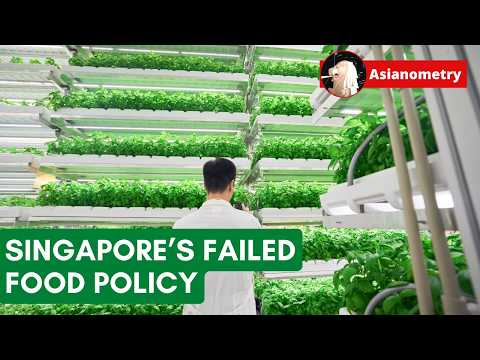
Singapore, once highly food secure through imports, aimed to produce 30% of its nutritional needs locally by 2030 via the 30-by-30 plan. Despite initial optimism and investments in vertical farming and agri-tech, challenges like high energy costs, funding issues, and market preferences led to failures. In 2025, the government scaled back goals, marking 30-by-30 as a rare policy setback.
Singapore, a small island nation with a population of about 6 million, has long been recognized as one of the world's most food-secure countries. Despite importing 90% of its food from over 170 countries, the city-state maintained a robust and diversified food supply chain. However, concerns over climate change and food security led the government to launch an ambitious initiative in 2019: the 30-by-30 plan, aiming to produce 30% of its nutritional needs locally by 2030 without significantly expanding farmland.
This article explores the history, challenges, and eventual scaling back of this bold agricultural policy.
At the time of Singapore's independence in 1965, about 60% of the food consumed by its 1.6 million people was grown locally. This included 25% of vegetables and 100% of pork, poultry, and eggs. The island had over 20,000 family farms cultivating approximately 13,160 hectares, which was about 22.5% of the island's land area.
However, rapid urban development demanded more land for housing, factories, and infrastructure. Housing alone consumed about 520 hectares annually in the 1960s. Environmental concerns, such as pollution from pig farms, led to government interventions like relocating pig farms to Punggol in 1974.
Despite efforts to intensify production, cultivated land steadily declined, dropping to 10,595 hectares by 1979 and only 267 hectares for vegetable farming by 1980.
By the 1980s, agriculture contributed less than 2% of Singapore's GDP. The government began phasing out pig farms in 1984 due to pollution concerns and shifted focus away from self-sufficiency in pork, chicken, and eggs. Instead, Singapore aimed to leverage its competitive strengths and rely on imports.
This shift was a blow to local farmers who had invested heavily in modernization and relocation. By 1986, local production still accounted for significant portions of pork (73%), eggs (68%), and chicken meat (41%), but these numbers declined sharply after the phase-out.
Remaining farms were consolidated into "Agrotechnology" parks in isolated areas, with only about 600 hectares (1% of land) left for farming.
Singapore's strategy to mitigate import dependency has been diversification. The country sources food from over 170 nations and actively seeks new suppliers. For example, when Malaysia restricted chicken exports in 2022, Singapore smoothly switched to Indonesian supplies.
The government also mandates stockpiling critical foods like rice, wheat, eggs, flour, and milk powder. In 2019, the Economist Intelligence Unit ranked Singapore as the most food-secure country out of 113, citing affordability, availability, quality, and safety.
However, concerns about over-reliance on imports and global supply disruptions persisted, especially after the 2007-2008 grain price spikes.
In 2018, Singapore consolidated food-related functions into the Singapore Food Agency (SFA). In 2019, Minister Masagos Zuklifli set the goal for Singapore to produce 30% of its nutritional needs locally by 2030, inspired by the country's success in water self-sufficiency.
The plan emphasized high-tech, climate-resilient agriculture, including vertical farming, aquaculture, and food waste recycling. The SFA aimed to develop local technologies and eventually export them.
In 2019, local farms produced about 13% of green leafy vegetables, 10% of fish, and 26% of eggs. Achieving 30% seemed technically possible, especially with vertical farming, which could produce high yields on small land areas.
The strategy included:
The COVID-19 pandemic disrupted supply chains and delayed construction and labor availability for local farms. However, it also reinforced the importance of local food production.
Vertical farms require significant electricity for climate control and lighting. With 95% of Singapore's energy from natural gas, prices surged due to geopolitical tensions, especially after Russia's invasion of Ukraine in 2022.
Electricity costs rose from 22.7 cents per kWh in 2021 to nearly 30 cents in 2024, making vertical farming economically challenging.
The US Federal Reserve's aggressive interest rate hikes from 2022 to 2024 increased capital costs, drying up venture capital funding for agri-tech by 60%. Singapore's grants covered only setup costs, not ongoing operations, and focused on high-tech ventures, leaving traditional farmers unsupported.
Efforts to promote local produce faced resistance due to significant price differences. Imported leafy greens cost about $2 per kilo, while indoor-farmed products sold in small packages cost $3-4, making local produce less attractive to price-sensitive consumers.
Several startups and initiatives failed or ceased operations between 2023 and 2025, including:
These failures mirrored global struggles in vertical farming and alternative protein sectors.
Additionally, bureaucratic hurdles delayed farm startups, with approval processes taking up to 106 weeks compared to 8-20 weeks in the US.
By 2025, the 30-by-30 goal was deemed unattainable in its original form. The government replaced it with more modest targets for 2035:
Minister Grace Fu acknowledged the aspirational nature of 30-by-30 and highlighted successes such as achieving 30% egg self-sufficiency and 50% bean sprout production.
The Lim Chu Kang agri-food zone development continues, but the future of local farming remains uncertain.
Singapore's 30-by-30 initiative stands as a rare public policy failure but also a valuable experiment. It underscores the challenges of pursuing food self-sufficiency in a land-scarce, energy-dependent city-state and highlights the need for realistic goals, supportive policies, and consumer engagement.
Food self-sufficiency remains a worthy aspiration, but Singapore's experience offers important lessons for other nations seeking to balance food security, sustainability, and economic viability.



















