
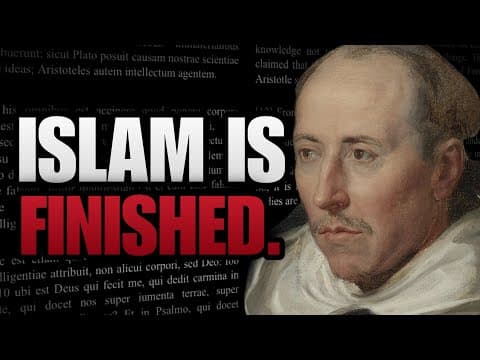
This blog post explores St. Thomas Aquinas' arguments against Islam as presented in his work, Suma Contra Gentiles. It examines the historical context, the nature of divine revelation, and the criteria for verifying claims of divine authority. The analysis highlights the differences between Catholicism and Islam regarding signs of divine origin, including miracles, moral teachings, and the spread of each faith.
In the year 1265, St. Thomas Aquinas completed one of the most significant theological works in history, the Suma Contra Gentiles. This book was designed as a comprehensive apologetic text to establish the rational basis of the Catholic faith, specifically aimed at refuting the beliefs of Jews, Muslims, heretics, and others. Throughout history, this work has been a cornerstone for the education of seminarians and has influenced many popes, including Pope Francis.
A particular section of the Suma Contra Gentiles, found in the sixth chapter of the first book, has sparked considerable debate, especially regarding its critique of Islam. In this passage, St. Thomas makes several claims about Muhammad and the nature of his teachings. He argues that Muhammad attracted followers through promises of carnal pleasures and that his teachings were mixed with falsehoods. St. Thomas asserts that the followers of Muhammad were not wise individuals but rather ignorant men who were compelled to accept his law through force.
St. Thomas writes:
"Muhammad enticed peoples with the promise of carnal pleasures... He also delivered commandments in keeping with his promises... Nor did he add any signs of supernatural agency which alone are a fitting witness to divine inspiration..."
This passage has been interpreted in various ways, with some defending St. Thomas's position while others criticize it for its perceived inaccuracies and biases.
To fully grasp St. Thomas's argument, it is essential to understand the fundamental problem he addresses: how can one verify that someone claiming to speak for God is indeed a divine messenger? This question is not limited to Islam but applies to any claim of divine revelation. St. Thomas emphasizes the need for adequate signs that confirm a prophet's divine authority, warning against credulity—the tendency to believe without sufficient evidence.
St. Thomas identifies a vice called credulity, which refers to the inclination to believe important claims on insufficient grounds. He illustrates this with an analogy: if someone were to receive a phone call from a stranger claiming to be a government official demanding money, believing them without verification would be credulous. This principle applies to religious claims, where the stakes are infinitely higher.
St. Thomas distinguishes between negative signs, which remove obstacles to belief, and positive signs, which confirm divine origin.
Negative signs indicate that a claimed revelation is not from God. For instance, if a doctrine contradicts natural reason or previous divine revelations, it can be disqualified. St. Thomas argues that Islam contradicts both the Old and New Testaments and lacks the intellectual endorsement of wise men, which he claims is indicative of its falsehood.
Positive signs, on the other hand, are those that affirm a revelation's divine origin. These can include:
St. Thomas contends that Islam lacks both types of positive signs, while Catholicism possesses them abundantly.
St. Thomas argues that the rapid expansion of Islam can be attributed to natural causes rather than divine intervention. He points out that Islam promised carnal pleasures, making it appealing to many. In contrast, Christianity, which teaches restraint and self-denial, spread despite persecution and hardship.
In summary, St. Thomas Aquinas presents a compelling argument that Catholicism surpasses Islam in terms of divine origins. He argues that Catholicism is supported by miracles, prophetic testimony, and a moral framework that transcends natural human understanding. Through a direct comparison, he illustrates that while Islam lacks these signs, Catholicism is rich in evidence of divine revelation.
This analysis of St. Thomas's critique of Islam not only sheds light on his theological positions but also invites further reflection on the nature of faith, revelation, and the criteria by which we assess claims of divine authority.



















