
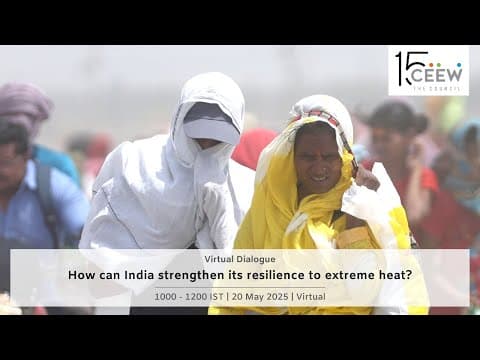
This blog post discusses the critical issue of extreme heat in India, highlighting the findings from a recent study on heat resilience. It covers the impacts of heat on health, the importance of heat action plans, and the need for collaborative efforts among various stakeholders to address this growing challenge. The post also emphasizes the role of data-driven solutions and innovative approaches like parametric insurance to enhance resilience against heat stress.
Extreme heat is becoming an increasingly pressing issue in India, affecting millions of lives and livelihoods. With rising temperatures and changing climate patterns, understanding and addressing heat resilience is crucial for the well-being of the population. This blog post summarizes key insights from a recent dialogue hosted by the Council on Energy, Environment and Water (CEW) on how India can strengthen its resilience to extreme heat.
Vishwas Chitalle, leading the climate resilience team at CEW, opened the discussion by emphasizing the urgency of addressing heat resilience in India. While some regions, like Pune, may experience rainfall, others, such as Delhi, are grappling with severe heat crises. The mixed weather patterns of the current year highlight the need for a comprehensive understanding of heat risks and the districts most affected by heat stress.
Shalu Agarwal, Director of Programs at CEW, pointed out that heat is no longer just a weather pattern; it is a significant climate risk that shapes how people live and work. Last year, 37 Indian cities recorded temperatures exceeding 45°C, and February 2023 was the hottest in over a century. The combination of high humidity and warmer nights exacerbates heat stress, particularly affecting vulnerable populations such as farmers, informal workers, the elderly, and children.
The event included the launch of a study aimed at mapping heat stress across 734 districts in India. This study utilized 35 indicators to assess heat hazards, exposure, and vulnerability, moving beyond traditional metrics to include nighttime heat and humidity levels. The findings underscore the need for localized solutions and collaborative efforts among various stakeholders, including government agencies, climate researchers, urban planners, and health systems.
Dr. Madhavan Rajivan, a key speaker, highlighted the importance of understanding heat waves and heat stress. He emphasized that while heat waves are meteorological events, heat stress refers to the physiological strain on humans due to high temperatures and humidity. The need for a clear definition and index for heat stress in India was stressed, as current forecasting systems primarily focus on heat waves.
The dialogue emphasized the need for collaboration across various sectors. Miss Sugata Sonik, Chief Secretary of Maharashtra, noted that managing heat requires a year-long effort, not just a response to high temperatures during summer months. The importance of localized, data-driven solutions was reiterated, with a focus on updating existing heat action plans based on new findings.
One innovative approach discussed was the implementation of parametric insurance for heat-related risks. This insurance model provides financial protection based on predefined temperature thresholds, offering a safety net for vulnerable populations. The success of pilot programs in states like Nagaland demonstrates the potential for scaling such solutions across India.
As India faces the growing challenge of extreme heat, strengthening resilience requires a multifaceted approach. By leveraging data, enhancing collaboration, and implementing innovative solutions like parametric insurance, India can better prepare for the impacts of heat stress. The insights from the recent dialogue serve as a crucial step towards building a more resilient future for all citizens.
Stakeholders at all levels are encouraged to engage with the findings of the heat resilience study and consider how they can contribute to developing effective heat action plans. Together, we can work towards a sustainable and resilient future in the face of rising temperatures.



















