
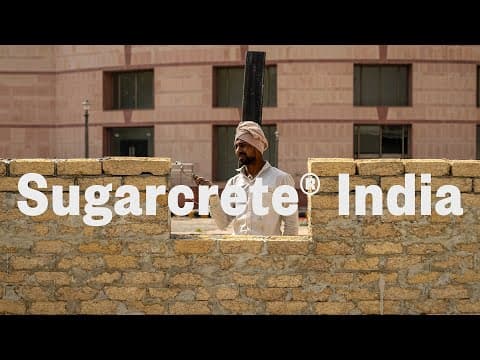
Sugarcrete® is an innovative construction material developed from sugar cane byproducts, aiming to promote sustainability in India by reducing soil depletion and providing economic opportunities for local communities.
In a groundbreaking initiative, the University of East London has developed Sugarcrete®, a sustainable construction material made from the byproduct of sugar cane, known as bagasse. This innovation not only addresses environmental concerns but also aims to uplift local economies in India.
Sugar cane is known for its remarkable ability to absorb carbon dioxide, doing so at a rate 50 times faster than traditional forestry. This characteristic makes Sugarcrete® a highly sustainable alternative to conventional building materials. The initiative seeks to upcycle bagasse, which is often discarded, into a valuable resource for construction.
The University of East London has partnered with Chemical System Technologies (CST) in India to establish the first manufacturing facility for Sugarcrete®. This collaboration is pivotal as it translates laboratory research into practical applications, creating a viable product for the construction industry.
One of the significant challenges in India is the depletion of topsoil due to the heavy energy consumption associated with traditional brick production. The extraction of topsoil not only affects the environment but also hinders agricultural output, which is critical for a country like India. By producing Sugarcrete® blocks close to sugar mills, the initiative aims to mitigate these issues, preserving topsoil and promoting sustainable practices.
The project also focuses on empowering local communities, particularly women, by incentivizing them to participate in the production of Sugarcrete® blocks. This initiative not only provides additional income for these individuals but also stimulates the local economy, creating a win-win situation for both the community and the environment.
A significant aspect of the Sugarcrete® initiative is its commitment to education and skill development. The project includes a curriculum designed to train local individuals in sustainable construction practices. The aim is to create a knowledgeable workforce that can engage in and promote sustainable building techniques.
As part of the initiative, a prototype building has been constructed using Sugarcrete®. This structure serves as a demonstration of the material's capabilities and provides a learning environment for students. The building is designed to be soundproof and temperature-controlled, showcasing the potential of Sugarcrete® in creating comfortable and efficient spaces.
The Sugarcrete® project represents a significant step towards sustainable construction in India. By utilizing sugar cane byproducts, it addresses environmental concerns, supports local economies, and provides educational opportunities. The successful implementation of this initiative could pave the way for similar projects worldwide, promoting sustainability in the construction industry and beyond.



















