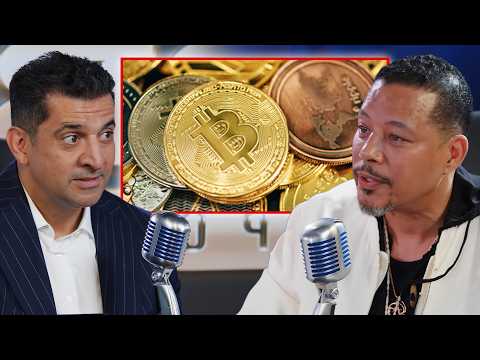
Terrence Howard discusses the decline of the US dollar, rising global economic tensions, and the shifting alliances involving China, Russia, and Africa. He highlights the suppression and potential surge in silver prices, critiques Bitcoin's viability, and emphasizes the need for diplomatic approaches in global politics. Howard warns that Bitcoin is likely to fail due to its ties to fiat currency and global instability.
Terrence Howard, known primarily as an actor but also engaged in scientific discussions, recently shared his insights on the current global economic landscape, geopolitical tensions, and the future of cryptocurrencies like Bitcoin. His analysis touches on the decline of the US dollar, the rise of China and Russia as global powers, the precious metals market, and the precarious position of Bitcoin.
Howard begins by addressing the weakening position of the US dollar on the world stage. He notes that over the past 12 months, the US dollar has lost approximately 9% of its purchasing power. This decline is significant as it affects the global financial system, where only 51% of the world still relies on the US dollar for transactions, down from a much higher percentage previously.
He highlights that 25 countries have adopted the Chinese yuan (referred to as the "bricks" countries) for trade, signaling a shift away from dollar dependency. Saudi Arabia's decision to stop selling oil exclusively in US dollars is a critical indicator of this change.
Howard also discusses the impact of US tariffs and trade restrictions, such as those imposed on Canada, which have led to retaliatory measures including tariffs on electricity exports and withholding minerals. These trade tensions contribute to a bottleneck in the global economy.
Turning to commodities, Howard emphasizes the importance of precious metals, particularly silver and gold, in the current economic climate. He explains that silver prices have been artificially suppressed for decades, citing JP Morgan's recent $920 million fine for manipulating the silver market through paper contracts.
There is now a divergence between the price of silver futures in the US and the actual silver price in Shanghai, eliminating traditional arbitrage opportunities. Silver is crucial for modern electronics, solar panels, and electric vehicles, yet global production is limited, with China hoarding significant quantities.
Interestingly, JP Morgan has recently acquired 750 million ounces of silver, signaling a potential shift. Howard predicts that silver's value could rise dramatically, potentially reaching parity with gold, with ratios moving from 30:1 or 50:1 to around 13:1.
Gold, after a period of suppression despite massive money printing during the COVID-19 pandemic, has begun to catch up, with prices potentially reaching $5,000 per ounce or higher as the US dollar weakens.
When asked about Bitcoin, Howard is unequivocal: he believes Bitcoin is going to die. He explains that Bitcoin is still fundamentally tied to fiat currency and is vulnerable to the declining value of the US dollar and global uncertainties.
Howard shares an anecdote about a friend proposing to invest $25 million to make $75,000 through Bitcoin-related accounts, which he declined due to concerns about Bitcoin's stability and its susceptibility to being wiped out by sudden market shifts.
He admits to holding less than 1% of his portfolio in Bitcoin and does not advocate for it. While acknowledging Bitcoin's historical price volatility—from $18,000 to $125,000 and back down—he remains cautious, noting that patterns may change but the risks remain high.
Howard delves into the geopolitical landscape, discussing how past US policies, such as Nixon's opening of China to counter the Soviet Union, inadvertently empowered China to become a global economic powerhouse.
He points out that China now competes with the US and has formed strategic alliances with countries that are turning away from the US, including many African nations. Russia also plays a significant role, supporting African leaders like President Ibrahim Traore in their efforts to resist colonial exploitation and assert control over their resources.
The standoff in the Strait of Hormuz, involving US, Chinese, and Russian naval forces, exemplifies the complex power dynamics. Howard warns that any US strike on Iran could escalate into a world war due to these alliances.
Howard critiques the US approach of isolation and tariffs, suggesting that it is no longer effective in a globalized economy. He advocates for a return to diplomacy and partnership on the world stage, emphasizing that the US must adapt to the reality that the dollar is no longer the sole global currency.
He praises China's Belt and Road Initiative as a smart move to build alliances without imposing strict conditions, contrasting it with the US's more confrontational stance.
The discussion touches on the origins of the COVID-19 pandemic, with Howard asserting that the virus leaked from the Wuhan lab and that China could have acted sooner to contain it. He also suggests that the global response, including lockdowns and vaccinations, was coordinated by globalist forces aiming for a new world order.
Howard emphasizes that the current political divide is less about Republicans versus Democrats and more about globalists seeking to reshape the world.
Terrence Howard offers a comprehensive and critical perspective on the current state of global economics, geopolitics, and the future of cryptocurrencies. He warns that Bitcoin, tied to the unstable fiat system, is unlikely to survive, while precious metals like silver and gold may become increasingly valuable.
He calls for a shift in US foreign policy towards diplomacy and partnership, recognizing the changing global power structure dominated by China and Russia. Howard's insights highlight the interconnectedness of economic policies, geopolitical strategies, and technological assets in shaping the future.
For those interested in engaging further, Howard invites conversations through his platform Man, signaling his openness to dialogue on these pressing issues.