
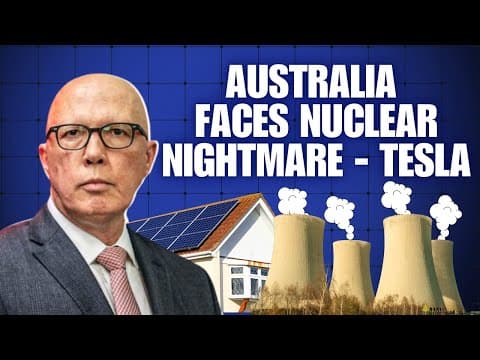
Tesla argues that Australia's shift towards nuclear energy could lead to significant economic losses, as the country already has abundant renewable resources. The transition to nuclear may hinder the growth of solar and battery technologies, ultimately costing consumers billions.
As Australia approaches a pivotal election, the debate over the future of its energy grid intensifies. The current government, leaning towards a Republican stance, proposes a significant shift from a renewable energy-based system to one reliant on nuclear power. However, experts, including Tesla, are raising alarms about the potential economic ramifications of this plan.
Tesla has identified a critical issue with nuclear energy that many experts seem to overlook. The company argues that transitioning to nuclear could result in billions of dollars wasted. This concern is particularly relevant in Australia, a country blessed with abundant sunlight, making the push for nuclear energy seem counterintuitive.
Tesla claims that the government's nuclear plan will ultimately harm consumers, potentially costing them hundreds of millions of dollars. The argument is that nuclear power plants are notorious for exceeding their projected costs and timelines. Historically, no nuclear power plant in the Western world has been completed within budget or on schedule. If Australia were to initiate the construction of a nuclear facility today, it could take at least a decade to complete, leaving a significant gap in energy supply as coal plants are phased out.
Tesla advocates for a renewable energy strategy, emphasizing that renewables are not only the cheapest form of energy but also increasingly accessible. The company suggests that empowering households with solar panels and battery systems is a more effective approach. By incentivizing residential solar installations, Australia could enhance its energy independence and reduce reliance on large-scale nuclear projects.
As coal power plants in Australia face economic challenges and are set to close, the private sector is already pivoting towards renewable solutions. For instance, the owner of a major coal power station plans to replace it with one of the largest battery installations in the world. This shift indicates that the market is moving towards solutions that are economically viable and environmentally sustainable.
Tesla's analysis highlights several flaws in the government's nuclear strategy:
Tesla argues that by the time nuclear plants are operational, the energy landscape will have changed dramatically. The cost of solar and battery technologies is expected to decrease further, making them even more attractive options for consumers. The current trajectory suggests that households will increasingly rely on their solar systems and electric vehicles to meet their energy needs, rather than on large-scale nuclear facilities.
Batteries are positioned as a viable alternative to traditional baseload power sources. Tesla asserts that with advancements in battery technology and the growing adoption of electric vehicles, households will be able to store and utilize energy more efficiently. This shift could mitigate the need for nuclear power altogether.
The push for nuclear energy in Australia, as advocated by the current government, raises significant concerns about economic viability and energy sustainability. Tesla's insights suggest that a focus on renewable energy and battery storage could provide a more effective and economically sound solution for Australia's energy future. As the election approaches, voters must consider the long-term implications of their choices on the country's energy strategy and economic health.



















