
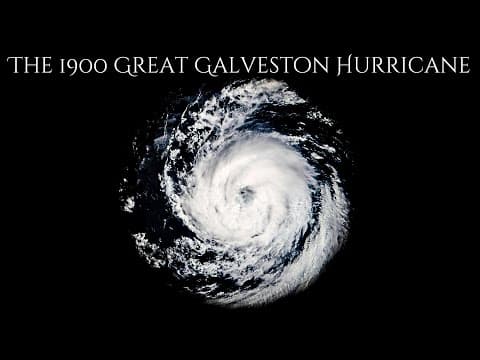
The 1900 Galveston Hurricane, the deadliest natural disaster in U.S. history, resulted from a combination of meteorological miscommunication and willful ignorance, leading to catastrophic loss of life and significant changes in weather forecasting practices.
On September 8, 1900, a Category 4 hurricane struck the coastal town of Galveston, Texas, with sustained winds exceeding 130 mph. This disaster became the deadliest natural catastrophe in U.S. history, claiming an estimated 8,000 lives. However, the story of the Great Galveston Storm is not just about the hurricane itself; it serves as a cautionary tale about the consequences of willful ignorance in weather forecasting.
Incorporated in 1839, Galveston was a burgeoning port city by the turn of the 20th century, boasting a population of nearly 40,000. The city was known for its beautiful beaches and thriving economy, often referred to as the "Wall Street of the South." Among its prominent residents was Isaac Klein, head of the local weather bureau, who had a reputation for his forecasting skills.
Despite experiencing several tropical storms, the residents of Galveston had grown complacent, believing that past storms were not severe enough to warrant concern for future hurricanes. Klein himself had previously published an article claiming that a significant hurricane could not strike Galveston, which contributed to the community's dismissive attitude towards the potential threat.
In 1900, meteorological science was still in its infancy. Although weather observation tools had been in use for nearly a century, the understanding of tropical storms was limited. The U.S. Weather Bureau had recently begun to establish a network of observation stations, but many forecasters struggled to predict the paths of violent coastal storms.
A notable exception was a meteorological observatory in Havana, Cuba, which had some of the best tropical forecasters of the time. As the summer of 1900 progressed, a tropical wave emerged off the coast of Africa, eventually developing into a storm that would threaten the Gulf Coast.
By August 30, 1900, the storm had intensified into a weak tropical storm as it moved through the Caribbean. However, discrepancies arose between the forecasts from the U.S. Weather Bureau in Washington, D.C., and those from the Havana office. While the Washington office predicted the storm would curve towards Florida, forecasters in Havana believed it was headed for the Gulf Coast.
Despite warnings from the Havana office, the chief of the U.S. Weather Bureau, Willis Moore, dismissed their predictions, leading to a critical failure in communication. This arrogance and refusal to acknowledge the expertise of Cuban forecasters would have dire consequences.
On September 6, 1900, reports indicated that the storm had intensified into a hurricane, but the Washington office continued to downplay its severity. By September 8, the hurricane made landfall in Galveston, bringing catastrophic winds and a devastating storm surge. Eyewitness accounts describe the water rising dramatically, with some areas experiencing a surge of up to 15 feet.
The destruction was immense. Buildings were swept off their foundations, and the city was left in ruins. Isaac Klein, who had been monitoring the storm, faced personal tragedy as he fought to save his family amidst the chaos.
In the wake of the hurricane, Galveston was left with a staggering death toll. Estimates suggest that between 6,000 and 12,000 people lost their lives, with the most credible figure being around 8,000. The recovery efforts were daunting, with many bodies needing to be recovered and buried, often by African American men forced to do so under duress.
The city officials and residents worked tirelessly to rebuild Galveston. Within a week, contributions for recovery efforts exceeded $1.5 million, with significant donations coming from major cities across the country. Clara Barton and the American Red Cross also played a crucial role in providing aid.
The tragedy of the Galveston hurricane prompted significant changes in weather forecasting practices. The U.S. Weather Bureau established regional forecast offices to improve communication and accuracy in predictions. Isaac Klein was promoted and moved to Louisiana, where he continued his career in meteorology.
In the years following the disaster, Galveston implemented measures to protect against future hurricanes, including the construction of a seawall and raising the city itself. These efforts proved beneficial when a storm of similar strength struck in 1915, resulting in far fewer casualties due to the improvements made.
The 1900 Galveston Hurricane remains a tragic reminder of the importance of accurate weather forecasting and the dangers of complacency. It reshaped not only the city of Galveston but also the practices of meteorology in the United States. Over a century later, Galveston continues to thrive, honoring the memory of those lost in the storm while serving as a testament to resilience and recovery.



















