
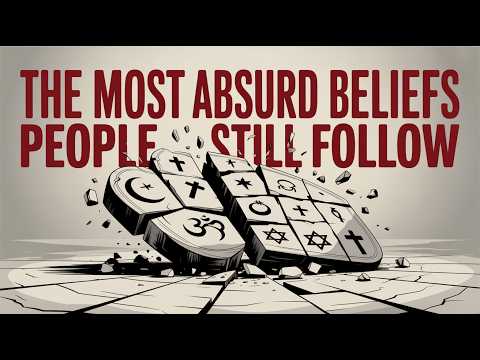
This article explores the irrationality of various religious beliefs that persist today, highlighting how they often contradict logic, science, and ethics. It argues that many of these beliefs are maintained through fear and tradition rather than truth, and emphasizes the importance of questioning and scrutinizing beliefs to foster progress and understanding.
In today's world, there are numerous beliefs that, if stripped of their religious labels, would be dismissed as absurd. Yet, when these beliefs are cloaked in the guise of religion, they gain a protective status that shields them from scrutiny. This phenomenon is not just peculiar; it poses significant dangers, as unchallenged beliefs can lead to harmful practices and societal issues.
One of the most striking examples of absurd beliefs is the notion that all humans are descended from just two individuals—one man created from dirt and one woman from his rib. This story, which includes a talking snake convincing a woman to eat from a magical tree, is not merely a metaphor for some; it is viewed as literal history. Such beliefs form the foundation of morality for many, despite being rejected in any rational historical context.
In some cultures, the belief that a divine being demands genital mutilation as a sign of loyalty persists. This practice, often involving the circumcision of baby boys, is defended by adults who make irreversible decisions for children based on ancient commands. In any other context, this would be classified as child abuse, yet it is often justified through religious doctrine.
There are individuals who pray to statues, believing these physical objects possess real power. They offer food, burn incense, and perform acts of devotion to these figures, convinced that they can bless or curse them. Such beliefs, which would be deemed delusional if applied to inanimate objects in everyday life, become normalized when framed as cultural practices.
Certain religions impose dietary restrictions based on the belief that consuming specific animals renders one's soul unclean. These prohibitions are not based on health concerns but rather on ancient texts written by individuals who lacked scientific understanding. Despite overwhelming evidence to the contrary, these rules are still followed as if they were universal truths.
In many religious traditions, women are required to cover their hair or faces, with the belief that a divine being is offended by their appearance. This leads to severe consequences for women who do not comply, including punishment and social ostracism. Such beliefs reduce women's autonomy and perpetuate harmful gender norms.
Some individuals believe that a divine entity is constantly monitoring their thoughts, actions, and relationships, tallying sins and determining their eternal fate. This belief creates a culture of fear and compliance, where individuals feel compelled to adhere to strict moral codes under the watchful eye of a higher power.
Many people hold the belief that chanting specific words or performing rituals can influence the universe in their favor. This magical thinking extends to health, where some reject modern medicine in favor of prayer, leading to tragic outcomes when faith healing fails. The persistence of such beliefs, even in the face of preventable deaths, highlights the dangers of unquestioned faith.
Despite overwhelming scientific evidence, some groups maintain that the Earth is only a few thousand years old and that evolution is a myth. They believe fossils are fabrications or divine tests of faith. This rejection of science in favor of ancient texts leads to a distorted understanding of the world and hinders progress.
Certain beliefs hold that individuals can retroactively change the beliefs of the deceased through rituals performed without their consent. This practice, which would be considered unethical in any other context, is viewed as noble within religious frameworks.
In some cultures, cows are revered as sacred beings, leading to practices that include feeding them first or even consuming their waste, believed to have healing properties. Such beliefs elevate animals to divine status, disregarding their biological nature.
The implications of these absurd beliefs extend beyond individual practices; they shape societal norms, laws, and healthcare. For instance, in some regions, access to contraception is restricted due to religious opposition, leading to overpopulation and poverty. Similarly, educational systems often dilute scientific facts to accommodate religious sentiments, creating a false equivalence between evidence-based science and ancient myths.
The most concerning aspect of these beliefs is the stigma surrounding questioning them. Doubt is often labeled as sin, and critical thinking is viewed as rebellion. This mindset perpetuates a culture where absurd beliefs are celebrated, and the pursuit of truth is discouraged.
In a world where information is more accessible than ever, it is crucial to challenge beliefs rooted in fear, shame, and magical thinking. Progress requires not only advancements in technology but also a commitment to critical inquiry and the courage to question long-held beliefs. Only by fostering an environment where doubt is welcomed can we begin to dismantle the absurdities that persist in our societies. Beliefs should serve as tools for understanding, not chains that bind us to outdated traditions. It is time to prioritize truth over tradition and to embrace a future where questioning is seen as a path to enlightenment rather than a moral failing.



















