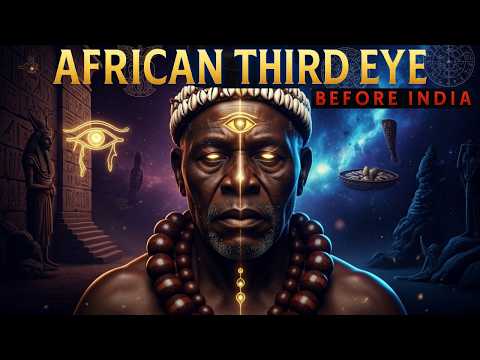
This article explores the African origins of the third eye concept, known as Ajna in Indian tradition. It reveals how African cultures like the Yoruba and Igbo have long cultivated spiritual sight—an inner vision beyond physical eyes—through sacred rituals, trance states, and divination. This ancient knowledge predates and informs the understanding of the third eye as a faculty of spirit, memory, and truth, deeply embedded in African identity and daily life.
Before the Ajna chakra was drawn in India, Africa had already opened the eye of spirit. In the deep stillness of sacred groves, under starlit skies, and through the unbroken lineage of seers, healers, and diviners, Africa saw—not with the physical eye, but with an inner eye that opens in silence. This eye dreams, remembers, and perceives beyond the visible.
This was not mere mysticism or metaphor. It was knowledge, science, and technology refined through generations, not in laboratories but in spiritual lineages. The third eye was not just a symbol; it was a faculty to be trained—a gateway to spirit, memory, and truth.
Long before the Ajna chakra had a Sanskrit name or was traced across foreheads by yogis, African spiritual practitioners such as the Babalaos, Masai elders, and Dogon initiates were already accessing this inner vision. Africa did not just recognize the inner eye; it mastered it.
From the sands of Kemmit to the forests of the Congo, from the mountains of Ethiopia to the deserts of Somalia, the ability to see beyond the material world was embedded in daily life, ritual, and identity. This spiritual sight influenced how kings ruled, healers diagnosed illnesses, and warriors moved with clarity.
The third eye is often associated with the East—India, Tibet, and the mystics of the Himalayas. However, this story is incomplete. The first eye that opened may have been African. This story is older than Sanskrit, the Vedas, and Asia itself. Africa’s vision was never limited to the visible because it understood that vision is not what we see but what sees through us.
Among the Yoruba people, the concept of the inner eye is called Oju-Inu, meaning "the eye inside." In Urue cosmology, this is not a metaphor but a sacred organ of perception that sees what cannot be seen and knows what has not yet happened.
The Balao, a priest of Ifa, does not seek answers by looking outward. Instead, he closes his physical eyes and opens the spiritual one. Guided by chants, invocations, and the sacred divination chain called Opele, the Balao enters a trance state to commune with Orunmilla, the Oria of wisdom, destiny, and foresight.
Orunmilla holds all memory and sees every soul’s path, choices, and possibilities. Through this connection, the Balao deciphers the verses of Odu Ifa—not by guessing but by seeing. This spiritual sight is used for healing, warning, and aligning lives with purpose.
In the Yoruba worldview, blindness is more than the absence of physical sight; it is a disconnection from inner clarity. One who lacks Oju-Inu may see the world but never truly understand it. Opening this inner eye is essential—it is the foundation of wisdom and the key to survival.
Across the Niger River, among the Igbo people, the third eye is known as Anamuu, the spirit eye. This gift belongs to the Debia, seers trained to pierce the veil between the visible and invisible worlds.
This sight does not depend on physical light but on spirit, silence, dreams, and invocation. The Debia use this spiritual vision to navigate realities beyond the material, accessing knowledge and guidance that inform their communities.
The African third eye, the Ajna before India, represents a profound spiritual faculty cultivated through ancient traditions. It is a testament to Africa’s deep understanding of inner vision, memory, and truth—an understanding that predates and enriches the global narrative of spiritual sight.
Africa’s spiritual eye never closed. It continues to inspire and inform the ways we perceive beyond the physical, reminding us that true vision is the ability to see through and beyond ourselves.