This article delves into the growing challenges faced by recent college graduates in the labor market, highlighting rising unemployment, underemployment, and the surge in unionization efforts among college-educated workers. Drawing from extensive journalism and personal stories, it examines the economic shifts, workplace struggles, and potential political implications of this evolving landscape.
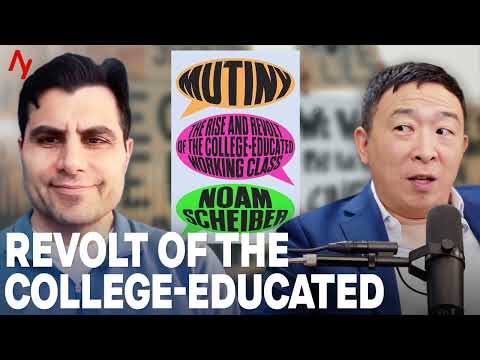
In recent years, a troubling trend has emerged: the steady increase in unemployment and underemployment rates among recent college graduates. This phenomenon has accelerated faster than the overall unemployment rate, signaling a significant shift in the labor market dynamics for the college-educated workforce. This article explores these challenges through the lens of Noam Scheiber's investigative journalism and his book Mutiny: The Rise and Revolt of the College-Educated Working Class.
Noam Scheiber, a journalist for the New York Times specializing in labor and workers, began his journey in the fall of 2021 when Starbucks workers in Buffalo started unionizing. Many of these workers were college graduates frustrated with their employment situations, often burdened by debt and working in demanding customer-facing roles during the pandemic.
Scheiber engaged with these workers through Zoom interviews, uncovering a pattern: a significant number of unionizing workers were college-educated individuals who had not found the career paths they expected post-graduation. Many had political experience, having volunteered for campaigns such as Bernie Sanders or Alexandria Ocasio-Cortez.
This initial reporting led to a broader investigation into the economics of the labor market for recent college graduates, culminating in a New York Times piece titled "The Revolt of the College-Educated Working Class" in early 2022.
Data from the New York Federal Reserve and research by economist Jesse Rothstein revealed that employment rates for recent college graduates had been declining even before the Great Recession and had not recovered a decade later. The pandemic exacerbated these issues, with unemployment rates for recent graduates rising steadily since 2022, surpassing the overall unemployment rate—a rare and concerning development.
This economic backdrop challenges the long-held belief that a college degree guarantees upward mobility and stable employment.
Scheiber's book goes beyond statistics, providing intimate portraits of individuals navigating this difficult landscape. For example:
Kaya Barrett, a communications graduate from Towson University, worked at an Apple store during college and stayed on full-time after graduation due to a lack of opportunities in her field. She faced severe financial hardship while taking leave to care for her niece, including missed paychecks, utility shutoffs, and car repossession.
Teddy Hoffman, a Grinnell College graduate and Watson Fellowship recipient, found himself working at Starbucks longer than anticipated after the pandemic disrupted his career plans. As he prepared for the birth of his first child, he struggled with reduced hours and pay, taking a second job and applying for public assistance.
These stories illustrate the emotional and financial toll on college-educated workers who find themselves in service jobs far removed from their expectations.
The book details the rise of unionization efforts among college-educated workers at companies like Starbucks, Apple, and Amazon. These campaigns are fraught with stress and risk, as workers face opposition from management, including stricter enforcement of workplace rules and legal challenges.
Scheiber describes the intense negotiations and the emotional strain on workers, highlighting the uneven power dynamics between employees and large corporations. For instance, union negotiations at Apple involved prolonged bargaining sessions where workers vented frustrations over the company's tactics.
The Amazon union campaign, while initially successful at a Staten Island warehouse, revealed tensions related to class, race, and education among workers, complicating efforts to expand unionization.
The phenomenon of an "oversupply of elites"—a surplus of college-educated individuals facing limited opportunities—has historical precedents linked to social and political upheaval. Scheiber references historical examples such as the Bolshevik Revolution and recent political unrest in Europe to suggest that the frustrations of underemployed college graduates can have significant political consequences.
This is evident in recent elections, such as the New York City mayoral race, where 84% of college graduates under 30 voted for a progressive candidate, indicating a desire for change among this demographic.
Despite high public support for unions (around 70%), actual union membership remains low due to legal and power imbalances favoring employers. Labor laws in the United States often fail to protect workers adequately, and unionization efforts can lead to retaliation and prolonged legal battles.
Alternative forms of collective action, such as minority unions and worker coalitions in the tech industry, are emerging as new ways for workers to organize and advocate for better conditions.
Looking ahead, the rise of artificial intelligence and automation threatens to further disrupt the job market for college graduates, potentially intensifying these challenges and fueling political activism.
The promise of a college degree as a guaranteed pathway to economic security and career success is increasingly broken. Through detailed reporting and personal narratives, Noam Scheiber's work sheds light on the struggles of the college-educated working class, their efforts to organize, and the broader implications for society and politics.
As the labor market continues to evolve amidst technological change and economic uncertainty, understanding and addressing the needs of this demographic will be crucial for shaping a more equitable future.
For those interested in exploring this topic further, Noam Scheiber's book Mutiny: The Rise and Revolt of the College-Educated Working Class offers an in-depth and humanized perspective on these pressing issues.