
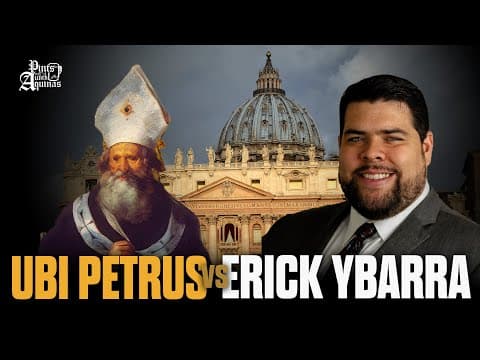
This blog post explores the recent debate between Eric Ybarra and Ubi Petrus regarding the concept of papal primacy as defined by Vatican I and its historical manifestations in the early Church. The discussion covers key historical events, theological interpretations, and the implications of papal authority in the context of the fifth and sixth centuries.
In a recent debate titled "Catholic-Orthodox Papacy Debate feat. Ubi Petrus vs. Erick Ybarra," the two scholars engaged in a thorough examination of the Vatican I concept of papal primacy and its historical manifestations in the early Church. This post aims to summarize their arguments, key points of contention, and the implications of their discussion on the understanding of papal authority.
Eric Ybarra, taking the affirmative position, argued that the Vatican I doctrine of papal primacy is rooted in the belief that Jesus conferred supreme authority to Peter alone, which is perpetuated in the bishop of Rome as Peter's successor. He outlined three main points:
Ubi Petrus countered that while the bishop of Rome had a universal primacy, it was mediated by canonical law and not absolute. He emphasized that the authority of the pope was not independent but rather a function of the broader ecclesiastical structure, where decisions were made collectively in councils.
Ybarra presented several historical instances to support his claims:
In contrast, Ubi Petrus argued that these historical events did not demonstrate the absolute authority of the pope as defined by Vatican I. He maintained that the actions of the early Church were more reflective of a conciliar model rather than a papal autocracy. He emphasized that the bishops often acted collectively and that the pope's authority was not exercised in isolation.
A significant point of contention was the role of councils in relation to papal authority. Ybarra asserted that the pope's involvement in councils did not diminish his authority but rather affirmed it. He argued that the pope's role was essential for the validity of council decisions.
Ubi Petrus countered that the councils operated as independent bodies and that the decisions made were not solely reliant on papal approval. He pointed out that the historical record shows instances where councils acted without direct papal intervention, suggesting a more collaborative ecclesiastical structure.
The debate between Ybarra and Petrus highlights the complexities surrounding the understanding of papal authority and its historical foundations. While Ybarra argues for a clear line of authority from Peter to the pope as defined by Vatican I, Petrus emphasizes the collaborative nature of early Church governance and the limitations of papal power. This discussion not only sheds light on historical interpretations but also raises important questions about the nature of authority within the Church today.
As the debate continues, it remains clear that the relationship between papal authority and conciliar governance is a nuanced topic that warrants further exploration and understanding.



















