
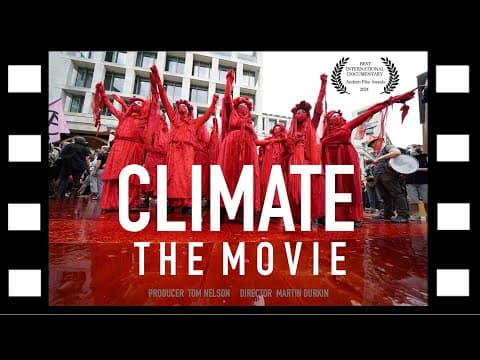
This blog post explores the controversial claims surrounding climate change, questioning the narrative of a climate emergency. It discusses the financial motivations behind climate research, the historical context of Earth's climate, and the role of natural factors in climate variability, challenging the mainstream consensus on climate science.
In recent years, climate change has become a central topic of discussion, often framed as an existential threat to humanity. However, this narrative is increasingly being challenged by a growing number of scientists and researchers who argue that the situation is not as dire as portrayed. This blog post delves into the claims surrounding climate change, the motivations behind climate research funding, and the historical context of Earth's climate.
The narrative of climate change has evolved into a powerful global industry, with trillions of dollars at stake. Critics argue that this has led to a self-serving cycle where climate researchers depend on funding to sustain their careers. The fear of losing financial support has created an environment where questioning the mainstream climate narrative is often met with hostility and intimidation.
Many scientists have expressed concerns about the integrity of climate research. They argue that the notion of a climate emergency lacks substantial evidence. For instance, prominent figures in the scientific community, such as Professor Steven Koonin and Dr. John Clauser, have pointed out that mainstream studies do not support the idea of a climate crisis. They emphasize the importance of scrutinizing data and questioning established narratives.
To understand the current climate debate, it is essential to look at Earth's climate history. Geological records indicate that the planet has experienced significant temperature fluctuations over millions of years. For example, during the time of the dinosaurs, temperatures were much warmer than today. In fact, the Earth is currently in a relatively cool period compared to its historical averages.
Geologists use various methods to reconstruct past climates, such as examining sediment layers and ice cores. These studies reveal that current temperatures are not unprecedented. For instance, the Holocene climate optimum, a period several thousand years ago, was significantly warmer than today. Furthermore, the Medieval Warm Period and the Little Ice Age demonstrate that climate has always been variable.
A common assertion is that rising levels of CO₂ are driving climate change. However, historical data suggests that temperature changes often precede increases in CO₂ levels. This challenges the narrative that CO₂ is the primary driver of climate change. Instead, natural factors, such as solar activity and cosmic rays, may play a more significant role in influencing climate.
Another factor complicating the temperature record is the urban heat island effect, where urban areas experience higher temperatures due to human activity. This phenomenon raises questions about the accuracy of temperature data collected from urban weather stations, which may not reflect broader climate trends.
The climate change narrative has led to the emergence of a vast industry focused on sustainability and climate compliance. This has resulted in the creation of numerous jobs and the proliferation of climate-related academic programs. However, critics argue that this industry thrives on the existence of a climate crisis, leading to a vested interest in maintaining alarmist narratives.
The climate debate is not solely scientific; it is deeply political. Many environmentalists advocate for increased government intervention in the economy, viewing climate change as a justification for expanding state power. This has led to policies that restrict individual freedoms and impose regulations on various aspects of life, from energy consumption to travel.
As the climate alarm narrative continues to dominate public discourse, there is a growing skepticism among ordinary people. Many are beginning to question the motives behind climate policies and the accuracy of climate predictions. This skepticism is fueled by the perception that climate change is being used as a tool for political and economic control.
The suppression of dissenting views in climate science raises concerns about the integrity of scientific inquiry. Critics argue that a healthy scientific discourse requires the ability to challenge prevailing narratives without fear of retribution. The current climate debate should encourage open discussions that consider all perspectives, rather than enforcing a singular viewpoint.
The narrative surrounding climate change is complex and multifaceted. While the potential impacts of climate change cannot be dismissed, it is crucial to approach the topic with a critical eye. By examining the historical context, questioning the motivations behind climate research, and fostering open debate, we can better understand the realities of our changing climate and the implications for society as a whole.



















