
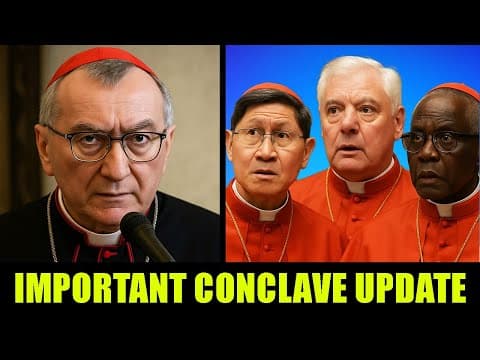
As the Vatican prepares for a pivotal conclave, whispers of uncertainty and speculation surround the candidates, particularly Cardinal Pin, whose recent health issues have raised concerns about his suitability for the papacy. Meanwhile, voices like Cardinal Mueller call for a return to doctrinal clarity, while potential successors emerge, each representing different visions for the future of the Church amidst a backdrop of spiritual dissonance and the need for healing.
In the heart of Rome, whispers have begun to ripple through the ancient halls and cloistered corridors of the Vatican. These murmurs speak not only of quiet uncertainty but of something far more unexpected. Behind solemn faces and ceremonial calm, questions are arising within the highest circles of the Church, not from rebellion or scandal, but from genuine concern over tradition and an unusual sequence of events that have cast a long shadow over what should be a sacred and unified process.
A new conclave is approaching, a moment meant to be marked by solemnity and spiritual clarity. However, what lies behind the doors this time feels different. It is not just the names being spoken in hushed tones or the growing speculation surrounding the outcome; it is the feeling that something unseen yet powerful is reshaping the very atmosphere of the Church's future.
As preparations for the conclave quietly accelerate, a wave of theories and interpretations has begun to surface, especially across online platforms and informal commentaries. Among these is a particularly persistent notion suggesting that the upcoming conclave could be rendered invalid due to procedural concerns. Some commentators have pointed to the number of cardinal electors expected to participate. According to this theory, if more than 120 cardinals are involved in casting a vote, the legitimacy of the conclave might somehow be compromised.
This idea traces its roots to a misreading of a key document issued by St. John Paul II, which established a structure for the conclave, including the recommendation that the number of voting cardinals not exceed 120. However, this was never intended as a rigid limit that could determine the validity of the election itself; rather, it was an administrative guideline, practical in nature and adaptable over time. Throughout history, this threshold has been exceeded multiple times without any canonical dispute or theological controversy.
Procedural speculation is not the only thing stirring unease within the Vatican. A new development, quiet but powerful, has drawn attention away from theoretical debates and toward something far more tangible. One of the most frequently named figures in discussions about papal succession, Cardinal Pin, has entered a period of sudden silence and absence that many insiders find difficult to ignore. Once viewed as one of the most formidable candidates to succeed, he has recently experienced a serious medical issue—a hypertensive episode that required immediate medical attention within Vatican City.
The sudden nature of this event has caused considerable concern among those gathered for the conclave. The memory of what happened in 1978, with the election of Pope John Paul II, whose passing only 33 days later left the world stunned, looms large. The Church does not wish to revisit that kind of heartbreak. Observers have noted a shift in Cardinal Pin's presence; his once commanding demeanor has softened into something more distant, appearing increasingly isolated and less engaged in theological discussions.
As murmurs among certain members of the College of Cardinals grow louder, hesitation surrounding Cardinal Pin's suitability for the role of the next pontiff has become evident. Words like "rigid," "uninspiring," and "distant" have surfaced more frequently. While such comments remain off the record, they capture a deeper sentiment that is beginning to shape the quiet consensus: perhaps despite all his credentials, it simply isn't him.
Adding another layer to the unease is a controversial episode involving an external figure—a well-known American religious leader who offered an unusually public endorsement of Cardinal Pin as the ideal candidate for the papacy. While intended as a compliment, this endorsement was met with dismay rather than gratitude. The figure's polarizing remarks and questionable affiliations are not viewed as constructive influences within the Vatican. The endorsement framed Cardinal Pin as a symbolic bridge for global unity, which many saw as reducing the spiritual identity of the Church to a mere political utility.
In contrast to the uncertainty surrounding Cardinal Pin, Cardinal Gerhard Müller, the former prefect of the Congregation for the Doctrine of the Faith, has emerged with direct and impassioned commentary about the current state of the Church. Known for his deep theological knowledge and unwavering dedication to doctrinal clarity, Müller has warned against a future where the papacy is viewed as a platform of influence rather than a sacred calling marked by self-sacrifice.
Müller has expressed concern over the misuse of synodality, which he believes has become distorted into an ideological tool rather than a means of seeking unity in faith and mission. He has pointed to recent developments in Germany, where some dioceses have introduced blessings for unions that remain outside the sacramental framework, as evidence of doctrinal confusion.
As discussions about potential successors narrow, two prominent figures have emerged, each representing a different vision for the future of the Church. Cardinal Zuppi from Italy is known for his compassionate nature and commitment to peacebuilding, while Cardinal Tagle from the Philippines embodies a spirit of outreach that resonates with many in the modern world. Both candidates share a readiness to engage with the world and navigate the delicate balance between tradition and change.
However, there are also voices calling for a return to tradition, with Cardinal Péter Erdő emerging as a figure of theological clarity and ecclesial discipline. Erdő represents a possible middle path, offering a return to liturgical reverence and theological structure without alienating the broader body of believers.
The upcoming conclave is further complicated by the lack of cohesion among the College of Cardinals. For over a decade, they have not met regularly in a spirit of fraternity, which has weakened bonds of trust and made the process more unpredictable. Without strong alliances or clearly defined voting blocks, the conclave may be more open to the movement of the Holy Spirit than in times when strategies were tightly choreographed.
As the cardinals prepare to cast their sacred votes, they are not merely choosing a personality; they are discerning a future that must inspire the faithful and uphold the truths handed down through generations. The conversations now dig deeper into what kind of leadership the Church truly needs at this moment in its journey.
The need for spiritual discernment has never been more urgent. The question is no longer simply who will be elected but what that leadership will embody. Some cardinals are hoping for a shepherd who can offer spiritual clarity amid societal confusion, while others envision a pope who can engage with the disillusioned and wounded.
As the conclave begins, the faithful across the globe are united in prayer, seeking a leader who embodies both strength and gentleness, someone who knows when to teach and when to listen. The conclave is not merely an election; it is a sacred encounter, a gathering of those entrusted with a decision that reaches far beyond themselves.
As the sun rises over Rome on the morning of May 7th, the city awakens with a reverent stillness. The College of Cardinals is preparing to enter the Sistine Chapel, carrying the weight of the Church's past and future. The decisions made inside the conclave will not come easily, but they will be guided by the prayer of millions.
When the white smoke rises from the chimney, it will signal not just the election of a new pope but the awakening of the Church once more. The next pontiff will not simply guide Rome; he will guide the conscience of millions in a time of immense spiritual and cultural change. What the Church needs now is not a performer or a reformer driven by noise, but a father—a man who knows how to stand with strength, kneel with reverence, and lead not by force but by love.



















