
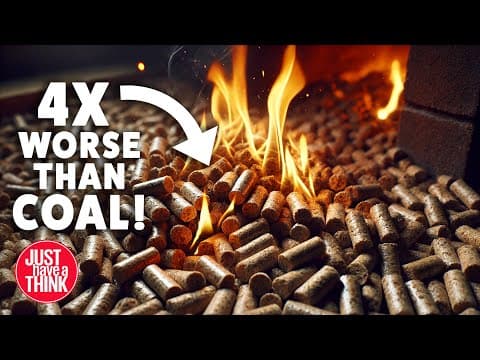
A recent analysis reveals that biomass energy, particularly from the Drax power station in the UK, produces four times more CO2 emissions than coal, raising concerns about the sustainability and environmental impact of biomass as a renewable energy source.
The industrial revolution of the nineteenth century brought about significant innovations, one of which was the steam-powered printing press. This advancement led to an increased demand for paper and pulp, resulting in large quantities of sawdust and wood chippings at sawmills. Initially, these waste products were burned for heat, creating a sustainable cycle. However, as demand grew, mill owners began to press this waste into wood pellets for sale, leading to the emergence of a global biomass industry.
By the end of the twentieth century, the biomass industry had expanded dramatically, often at the expense of ancient forests and ecosystems. A prime example of this is the Drax power station in the UK, which converted its boilers from coal to wood pellets, claiming to provide a renewable energy source. This transition has sparked significant debate among scientists and environmentalists regarding the true sustainability of biomass energy.
A recent analysis by Ember, a respected energy think tank, has revealed alarming statistics about the Drax power station. It has become the largest single source of carbon emissions in Britain, producing four times more CO2 than the country's last remaining coal-fired power station. This raises critical questions about the legitimacy of biomass as a renewable energy source.
In 2009, the European Union implemented the Renewable Energy Directive, which included biomass as a carbon-neutral energy source. This endorsement led to a doubling of European wood consumption for energy between 2000 and 2017. As European forestry laws restricted local timber use, the EU turned to the American biomass industry, which was struggling to remain profitable without government subsidies.
International carbon accounting rules classify the carbon content of trees in a way that allows biomass producers to claim zero emissions from burning wood. When trees are felled, the carbon is recorded as a minus figure in the country’s carbon inventory, creating a loophole that treats biomass as equivalent to renewable sources like wind and solar. This arrangement has been heavily influenced by lobbying from industry groups.
Industry lobbyists often create a false equivalence between large, slow-growing trees and fast-growing crops like corn, which can be quickly replanted. While corn can be considered carbon neutral due to its rapid regrowth, trees take decades to mature, meaning that CO2 is released into the atmosphere much faster than it can be absorbed by new growth. This discrepancy is critical in the context of the climate emergency.
Contrary to claims that biomass relies solely on waste products from mills, evidence shows that significant amounts of timber are being harvested specifically for pellet production. Environmental groups have documented instances of clear-cutting for biomass feedstock, undermining the argument that biomass is a sustainable alternative.
The Drax power station's operations exemplify the issues surrounding biomass energy. According to ecologist Mary Stuart Booth, the pellets consumed by Drax equate to clear-cutting a forest area of eighteen miles on each side. Drax has expanded its operations to include its own wood pellet plants in the US and Canada, aiming to increase production significantly by 2030.
The Ember analysis indicates that the UK biomass power sector accounts for 20% of the country's overall power sector emissions while providing less than 5% of its power. Biomass has a lower energy density than fossil fuels, requiring larger volumes to produce equivalent energy, resulting in higher CO2 emissions per unit of electricity than coal or gas. In 2022, Drax alone was responsible for 12.1 million metric tonnes of CO2 emissions, significantly more than the remaining coal plants in the UK.
The UK’s path to net zero heavily relies on negative emission technologies like Bioenergy with Carbon Capture and Storage (BECCS). Drax is the only UK power sector company developing BECCS technology, seeking government support for its project. However, the viability of BECCS is contingent on the biomass being genuinely carbon neutral, a claim that remains highly disputed.
The findings from Ember and the ongoing debate surrounding biomass energy highlight the urgent need for a reevaluation of its role in renewable energy strategies. As the scientific community calls for a shift towards proven low-emission technologies like wind, solar, and nuclear, the sustainability of biomass energy remains a contentious issue. The implications of these findings extend beyond environmental concerns, affecting energy policy and public funding in the UK and beyond.
As discussions continue, it is crucial for stakeholders, including industry professionals and environmental advocates, to engage in dialogue about the future of biomass energy and its impact on climate change.



















