
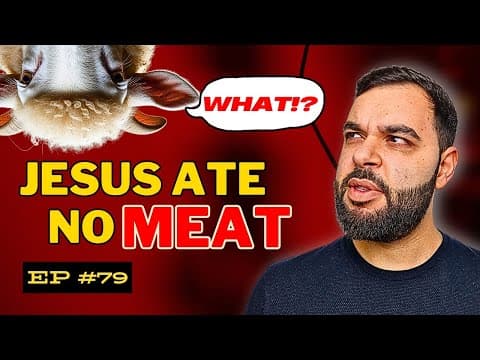
This blog post explores the controversial claim that Jesus was a vegan, as presented in the documentary 'Christ Spiracy.' It critiques the arguments made in favor of this claim, emphasizing the historical and biblical context of Jesus' life and teachings, and argues against the reinterpretation of scripture to fit modern ideologies.
In recent years, a peculiar movement has emerged, suggesting that Jesus Christ was a vegan and that his crucifixion was a consequence of his advocacy against animal sacrifice. This notion, popularized by the documentary "Christ Spiracy," has sparked debates among theologians, historians, and the general public. In this blog post, we will delve into the arguments presented in favor of this claim and critically analyze their validity.
The idea that Jesus was a vegan is not just a fringe belief; it has gained traction among certain groups who argue that his teachings align with modern veganism. Proponents of this view often cite Jesus' compassion for animals and his opposition to the sacrificial system as evidence of his dietary choices. However, this interpretation raises significant theological and historical questions.
The documentary "Christ Spiracy" posits that Jesus was crucified not for his teachings on sin and redemption but rather for his stance against meat consumption. This claim is met with skepticism, as it contradicts the traditional understanding of Jesus' mission and the context of his life.
One of the primary criticisms of the vegan Jesus argument is the misinterpretation of biblical texts. Advocates often twist scripture to fit their narrative, ignoring the historical context in which these texts were written. For instance, the sacrificial system established in the Old Testament was instituted by God and served a specific purpose in the Jewish faith. To claim that Jesus opposed this system entirely overlooks the significance of his role as the ultimate sacrifice.
The discussion around dietary choices in Christianity often references Romans 14 and 1 Corinthians 8, which address personal conscience regarding food. While some Christians may choose to abstain from meat for ethical reasons, the Bible does not label meat consumption as sinful. Instead, it encourages believers to respect each other's choices without imposing personal convictions as doctrine.
The argument that Jesus was against animal sacrifice fails to consider his Jewish heritage and the practices of his time. Jesus participated in the Passover, which involved the sacrifice of a lamb, a central aspect of Jewish tradition. This participation contradicts the claim that he was a vegan, as it would have required him to engage in the very practices he is said to oppose.
Furthermore, the New Testament provides accounts of Jesus eating fish and lamb. After his resurrection, he is described as eating fish with his disciples, which would not align with a vegan lifestyle. The insistence that these references are misinterpreted or that fish is not considered meat lacks substantial support.
A significant point raised in the documentary is Jesus' cleansing of the temple, which is portrayed as an act against animal sacrifice. However, the biblical account clearly states that Jesus was angered by the commercialization of the temple and the dishonesty of the merchants, not by the act of sacrifice itself. This misrepresentation further illustrates the lengths to which proponents of the vegan Jesus narrative will go to support their claims.
The movement to portray Jesus as a vegan is not merely a dietary preference; it represents a broader attempt to reshape Christian doctrine to fit contemporary ideologies. While discussions about ethics and diet are important, they should not come at the expense of historical and theological accuracy.
As Christians, it is crucial to engage with scripture faithfully and resist the temptation to impose personal beliefs onto biblical texts. The integrity of the gospel message must be preserved, and any reinterpretation should be approached with caution and respect for the original context.
In conclusion, while the vegan lifestyle is a personal choice for many, using Jesus as a figurehead for this ideology distorts his teachings and undermines the core tenets of Christianity. Let us honor the teachings of Christ without altering them to fit modern agendas.



















