
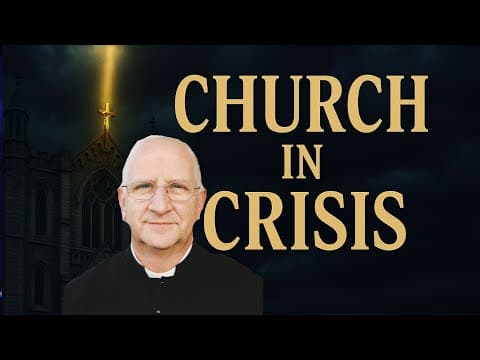
The crisis in the Church is fundamentally rooted in the collapse of sacrifice, where members prioritize lesser goods like comfort and worldly concerns over the greater good of virtue, holiness, and giving God His due worship. Understanding the true nature of sacrifice, its essential elements, and its analogies in life reveals how embracing sacrifice is key to overcoming the Church's spiritual, moral, and liturgical crises.
The Church today faces a profound crisis that touches every aspect of its life—liturgical, moral, spiritual, and institutional. While many factors contribute to this crisis, at its core lies a fundamental collapse of the concept and practice of sacrifice. This article explores the true meaning of sacrifice, its essential elements, and how the failure to embrace sacrifice has led to the Church's current troubles.
Sacrifice is often mentioned but rarely deeply understood. According to Petro Parente's Dictionary of Dogmatic Theology, sacrifice is "the offering and the real or equivalent destruction of a material thing performed by a legitimate minister and directed to God for the purpose of recognizing His lordship and expiating human guilt."
Three essential parts of sacrifice are:
The Offeratory: Setting apart the oblatada (the things offered) specifically for God’s worship. This involves detachment from the highest good—offering the best to God, both interiorly and exteriorly. The example of Cain and Abel illustrates this: Abel offered the best, Cain did not, and God rejected Cain’s sacrifice.
The Slaying of the Victim: The victim must die, either literally or metaphorically. This death is necessary for the consummation of the sacrifice.
The Consummation: The complete giving over of the victim to God, with no retention for oneself.
Sacrifice is always directed to God, and the full meaning is realized only when the offering is made to Him.
The sacrifice of Christ is the foundation of all sacrifices. His offeratory was His submission to the Father’s will: "Not my will, but Thine be done." The slaying was His Passion and death, and the consummation was the completion of His redemptive act.
The Mass is the atemporal participation in Christ’s sacrifice on Calvary. The priest’s role includes:
The laity participate by uniting their prayers, sufferings, and good works with the priest’s offering, dying to themselves, and receiving Communion.
Sacrifice is not limited to liturgical acts but permeates life:
Marriage: The offeratory is the proposal and acceptance; the slaying is the exchange of vows, where spouses die to self-will and bodily autonomy; the consummation is the full union.
Military Service: The offeratory is the willingness to serve; the slaying is the readiness to die in battle; the consummation is the full giving of life for the common good.
These examples show that sacrifice involves detachment from lesser goods for the sake of a greater good.
The Church’s crisis is deeply tied to a failure to sacrifice:
Worldliness in the Magisterium: Prioritizing issues like climate change over the salvation of souls.
Moral Failings Among the Faithful: Habitual mortal sin, lack of chastity, and secular living indistinguishable from the general populace.
Liturgical Crisis: Rejection of traditional forms of Mass to avoid offending modern sensibilities, leading to man-centered rather than God-centered worship.
Failure to Preach Truth: Avoiding preaching against sins like contraception and abortion to not offend.
Clerical Failures: Shuffling abusive priests rather than addressing the greater good of the Church and souls.
Loss of Disciplines: Abandoning fasting and penance to make Catholic life easier, sacrificing holiness for comfort.
Lack of Manliness in Clergy: Priests and bishops unwilling to sacrifice comfort and self-will, leading to a weakened Church leadership.
Sacrifice is the antidote to malice and spiritual mediocrity. It involves choosing the greater good—virtue, holiness, and God’s glory—over lesser goods like comfort and worldly approval.
The Virgin Mary’s message at Fatima emphasizes this:
"Pray, pray very much and make sacrifices for sinners, for many go to hell because there is no one to sacrifice and pray for them."
Sacrifice everything, detaching from all created goods so that God may fill our hearts completely.
Prayer and Penance: Deepening relationship with Christ through prayer and self-denial.
Learning the Faith: Understanding the true nature of sacrifice and virtue.
Offering Daily Sufferings: Uniting personal hardships with Christ’s sacrifice.
Embracing Roles and Duties: Accepting God-given roles in marriage, family, and society as calls to sacrifice.
Supporting Holiness in Clergy and Religious Life: Encouraging and praying for priests, bishops, and religious who live sacrificially.
Rejecting Comfort as a Priority: Choosing virtue over ease in daily decisions.
The crisis in the Church is not merely external but deeply spiritual, rooted in a widespread failure to embrace sacrifice. Sacrifice is the path to holiness, the means by which we give God His due and attain the greatest good.
By choosing the greater good over lesser goods, by dying to ourselves and offering everything to God, we can begin to heal the Church and ourselves. The call is clear: make everything a sacrifice and offer it to God, for in sacrifice, we lose nothing but gain everything.
Let us be a people who live sacrificially, worthy of the graces God desires to pour out through the Church, so that the crisis may be overcome and the Church renewed in holiness and truth.
This article is based on the teachings and reflections of Fr. Ripperger on the crisis in the Church and the essential role of sacrifice.



















