
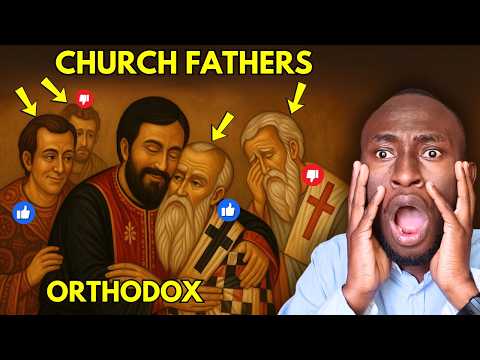
This blog post explores the issue of cherry-picking quotes from Church Fathers in theological debates, particularly between Catholics and Orthodox Christians. It emphasizes the importance of understanding the full context of their teachings on key doctrines such as the Eucharist, authority, and tradition, and how selective quoting can lead to confusion and division. The post encourages readers to engage with the Church Fathers holistically and to appreciate the continuity of faith within the mag
Have you ever noticed how quickly people appeal to the Church Fathers when they think those writings support their side of the argument? And how just as quickly they forget them when the same Fathers say something uncomfortable? This is a real problem, especially in discussions between Catholics and our Orthodox brothers and sisters. Both traditions claim continuity with the early Church and honor the Fathers, but too often, the Fathers are cherry-picked.
Certain passages are raised up as if they prove one's entire theology, while other passages, sometimes from the very same Father, are quietly ignored. The danger here is obvious. When we don't receive the Fathers as they really are, we twist them into mouthpieces for our own ideas. Instead of listening to them as witnesses to the apostolic faith, we risk misunderstanding their true teachings.
The Fathers are not Protestant, Orthodox, or modern Roman Catholics in the cultural sense. They are Catholic in the universal sense, standing in continuity with Scripture, tradition, and the living magisterium. This continuity can be uncomfortable and challenge our assumptions. However, when we let the Fathers speak fully, especially on topics like the Eucharist, the papacy, Mary, and the authority of the Church, we discover harmony that points unmistakably toward the Catholic Church today.
Why does cherry-picking the Fathers matter for your daily life? Because it's not just an academic game; it affects how we understand authority, sacraments, and salvation. Imagine building a house but only looking at the parts of the blueprint that you like. You love the kitchen design, so you build it, but ignore the foundation plan because it seems complicated. Eventually, the house collapses. This is analogous to how Christians often quote Saint John Chrysostom when he sounds Orthodox or Saint Augustine when he sounds Protestant, without holding all those teachings together.
Take the Eucharist as an example. Some argue that the Fathers only meant the Eucharist symbolically. However, if you read Ignatius of Antioch in his letter to the Smyrnaeans, he writes of those who abstain from the Eucharist and from prayer because they do not confess that the Eucharist is the flesh of our Savior Jesus Christ. This is not symbolic language; it is real presence language. Yet, the same people who happily quote the Fathers on liturgy or fasting often fall silent here. This selective reading creates confusion, division, and, worst of all, robs the faithful of confidence in the fullness of the faith.
Let's ground ourselves first in Scripture. Jesus said in John 16:13 that the Holy Spirit would lead the Church into all truth. This means truth develops in continuity, not contradiction. Paul commands in 2 Thessalonians 2:15 to stand firm and hold to the traditions taught by the apostles. Already in the apostolic age, oral tradition and written Scripture were both binding. When disputes arose, as in Acts 15 with the Council of Jerusalem, the Church gathered, and the apostles, particularly Peter, spoke with decisive authority. This is the seed of consiliar authority, Petrine primacy, and the living magisterium.
The Catechism of the Catholic Church echoes this in paragraph 78, stating that living transmission accomplished in the Holy Spirit is called tradition. In paragraph 82, it insists that the Church, to whom the transmission and interpretation of revelation is entrusted, does not derive her certainty about all revealed truths from Scripture alone. The Fathers understood this. They did not treat the Church as a loose federation of local communities but as one visible body guided by bishops in communion with the successor of Peter.
Consider St. Irenaeus in the second century in "Against Heresies." He appeals to the succession of bishops in Rome as the sure sign of the apostolic faith. He does not say to go read Scripture and interpret it however you like. Instead, he emphasizes looking at Rome, where the tradition from the apostles is preserved most faithfully. This is a Catholic statement, not merely an Orthodox or Protestant one.
Fast forward to the great councils at Nicaea, Constantinople, Ephesus, and Chalcedon. The Fathers hammered out the Trinity and Christology, but these councils did not just float in the air; they were ratified with the authority of the Bishop of Rome. Even St. Cyril of Alexandria, the champion at Ephesus, wrote to Pope Celestine submitting his judgment to Rome's confirmation. This is not a side detail; it is part of how the early Church worked.
Let’s not forget Marian doctrine. Orthodox Christians honor Mary but sometimes resist the later dogmas defined by the Catholic Church. Yet, already in the 4th century, St. Ephraim the Syrian praised Mary as all holy and without stain. St. Ambrose called her immune from all stain of sin. These are not Protestant sentiments and are not later medieval inventions; they are patristic insights that anticipate the Catholic dogmas of the Immaculate Conception and the Assumption.
Listen to the Church herself in modern teaching. In "Dei Verbum," the Second Vatican Council reminds us that sacred tradition and sacred Scripture form one sacred deposit of the word of God. The task of authentically interpreting this deposit has been entrusted exclusively to the living teaching office of the Church. This reflects what the Fathers lived, even if they did not use the precise vocabulary of councils like Trent or Vatican II.
So, how do we take this teaching and live it today? First, we must learn to receive the Fathers with integrity. Don’t just quote them to win an argument online. Read them devotionally and prayerfully, as witnesses to the same faith you profess in the creed every Sunday. When St. Augustine says, "Rome has spoken; the case is closed," he is not speaking as an isolated bishop but as a man who recognized the universal authority of Peter's successor. This should challenge you to examine how you view the magisterium today.
Second, apply this to your sacramental life. The Fathers consistently testify to the Eucharist as the real presence of Christ. St. Cyril of Jerusalem told catechumens, "Do not regard the bread and wine as simply that, for they are, according to the Master's declaration, the body and blood of Christ." To live that truth means to approach the altar with awe, confession, and reverence. If you find yourself doubting, don’t cherry-pick your feelings. Receive the fullness of testimony from Scripture, tradition, and the Fathers, and let that renew your Eucharistic faith.
Third, let it shape your unity. The Fathers were passionate about unity. St. Ignatius of Antioch constantly exhorted Christians to stick close to their bishop, to remain in one Eucharist, one altar, one Christ. Division was the hallmark of heresy. In our own day, the temptation is to retreat into little bubbles—Orthodox, Protestant, even independent Catholic groups. But the testimony of the Fathers pushes us toward visible unity under Peter. This is not just a theological point; it is a daily call. Pray for unity, resist gossip, forgive quickly, and refuse to let pride drive wedges in the body of Christ.
Fourth, know your catechism. It is not enough to quote isolated Fathers; you need to see how the Church today synthesizes their witness. Paragraph 888 teaches that bishops with Peter and under Peter proclaim the gospel authentically. This is the safeguard against cherry-picking. It means your faith isn’t a puzzle you have to assemble alone. The Church, guided by the Spirit, hands you the full picture.
Let’s address some counterpoints. Some Orthodox Christians may claim, "We also honor the Fathers. In fact, we preserve their teaching better than Rome." This is a serious claim, and we should respect the devotion behind it. The Orthodox do preserve much of the liturgical and spiritual life of the Fathers. Yet, the question isn’t who quotes the Fathers most beautifully; it’s who carries forward the fullness of their witness. On points like Petrine primacy, the Immaculate Conception, or the development of doctrine, Orthodoxy often stops short.
They may cite St. John Chrysostom on the liturgy but ignore Irenaeus on Rome. They may quote the councils but hesitate to acknowledge the pope's role in confirming them. Others might argue, "But doctrine developed later. The Fathers didn’t speak in modern Catholic categories." While this is true, development isn’t contradiction. It’s like an acorn growing into an oak tree. The DNA is there from the beginning. You don’t accuse the oak of being unfaithful to the acorn. Similarly, Catholic dogmas are developments faithful to the seed planted in Scripture and witnessed by the Fathers.
What are the key takeaways for you today?
You are not left alone in confusion. You belong to a Church guided by the Spirit, safeguarded by the magisterium, and nourished by the same Eucharist the Fathers adored. As St. Augustine once said, "The Church is your mother. If you will have God for your Father, honor the Church as your mother." This is not just poetry; it is your invitation to trust, to rest, and to walk in the fullness of Catholic truth.
If this inspired you, share it with a friend, subscribe, and keep walking this journey of faith with us. Christ is faithful, the Spirit is still guiding, and the Fathers are still speaking. If only we have ears to hear.



















