
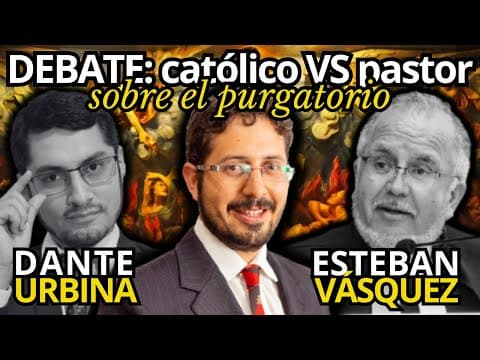
In a recent debate, Dante Urbina and Esteban Vásquez discussed the concept of purgatory and the authority of the Bible in Protestantism. The discussion highlighted the differences between Catholic and Protestant views on scriptural authority, particularly the principle of Sola Scriptura, and the implications for understanding early church practices.
In a recent debate hosted by Juan Carlos Monedero, Dante Urbina, a Catholic apologist, faced off against Esteban Vásquez, a Protestant pastor. The central theme of their discussion revolved around the concept of purgatory and the authority of the Bible within Protestantism. This blog post aims to dissect the key arguments presented during the debate, particularly focusing on the interpretation of Sola Scriptura and its implications for understanding early church practices.
The debate took place in a charged atmosphere, with both participants representing their respective theological backgrounds. Urbina, representing Catholic thought, questioned the Protestant view of the Bible as the sole authority, while Vásquez defended the Protestant stance that the Bible is the supreme authority in matters of faith and practice.
Dante Urbina posed a significant question to Pastor Vásquez regarding the early church's practices concerning purgatory. He referenced historical figures such as St. Augustine and Origen, who supported the idea of praying for the dead. Urbina's argument suggested that if the early church universally practiced this, it would be erroneous to dismiss their beliefs in favor of modern interpretations.
In response, Pastor Vásquez cited the Belgian Confession, Article 7, asserting that the Scriptures contain the complete will of God and that everything necessary for salvation is sufficiently taught within them. He emphasized that no one, not even angels, should teach otherwise than what is presented in the Holy Scriptures. This assertion underlines the Protestant belief that the Bible is the only rule of faith and conduct.
Vásquez further argued that the opinions of early church fathers are not authoritative in the same way as Scripture. He stated that the Protestant position does not rely on historical interpretations but solely on what is explicitly stated in the Bible. This led to a critical point in the debate: the rejection of any theological stance that does not have a direct scriptural basis.
The principle of Sola Scriptura, which translates to "Scripture alone," was a focal point of the debate. Pastor Vásquez reiterated that for Protestants, the Bible is the only infallible authority in matters of faith. He clarified that if a theological position, even if held by prominent Protestant theologians like Luther or Calvin, is not found in Scripture, it is not accepted.
This strict adherence to Sola Scriptura implies that any doctrine or belief must be directly supported by biblical text. This stance raises questions about the validity of historical theological interpretations and practices that may not be explicitly mentioned in the Bible. For instance, the acknowledgment of purgatory by some Protestant theologians does not hold weight if it is not found in Scripture according to Vásquez.
The debate between Dante Urbina and Esteban Vásquez highlighted the fundamental differences between Catholic and Protestant views on biblical authority and the interpretation of early church practices. While Urbina argued for the historical continuity of beliefs such as purgatory, Vásquez maintained that the Bible alone serves as the ultimate authority in matters of faith. This discussion not only sheds light on theological differences but also invites deeper reflection on how scripture is interpreted and applied in contemporary faith practices.
As the conversation around these topics continues, it is essential for believers to engage thoughtfully with both historical and scriptural perspectives to form a well-rounded understanding of their faith.



















