
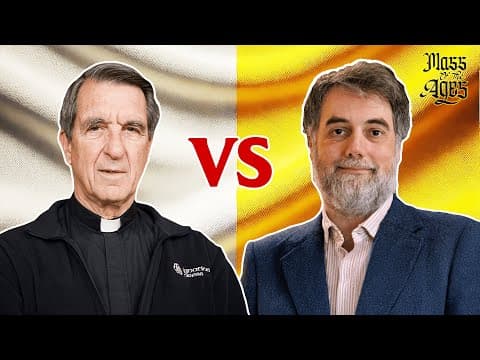
This blog post explores the ongoing debate between proponents of the Traditional Latin Mass and the Novus Ordo, highlighting key arguments from Fr. Fessio and Dr. Shaw regarding liturgical participation, reform, and the essence of worship.
The discussion surrounding the Roman liturgy has gained significant attention, particularly in the context of the Traditional Latin Mass (TLM) and the Novus Ordo Missae (New Order of Mass). This blog post delves into the insights shared by Fr. Fessio and Dr. Shaw, who present contrasting views on the future of liturgical practices within the Catholic Church.
In a letter dated April 19, 1995, Fr. Fessio reached out to Cardinal Ratzinger (later Pope Benedict XVI) regarding a talk by Father Brian Harrison. Harrison, who was the chairman of the theology department at the Catholic University of Puerto Rico, proposed a thesis that called for a reform of the reform of the Roman liturgy. His main points included:
Cardinal Ratzinger responded positively to Harrison's ideas, agreeing that they could lead to a genuine reform of the liturgy. This exchange laid the groundwork for the term "reform of the reform," which has since become a focal point in discussions about liturgical practices.
Fr. Fessio emphasizes the importance of Cardinal Ratzinger's work, particularly his book "The Spirit of Liturgy," which has significantly influenced his own understanding of liturgical practices. He argues that the Church needs to move beyond merely adhering to the extraordinary form of the Mass or strictly following rubrics. Instead, there should be a thoughtful reform that respects the explicit requirements of the Second Vatican Council.
Fr. Fessio believes that the essence of the liturgy should be rooted in a genuine encounter with the divine, rather than a mere intellectual exercise. He advocates for a liturgical experience that fosters a deep sense of devotion and reverence.
Dr. Shaw, while agreeing with many of Fr. Fessio's points, approaches the debate from a different angle. He expresses a concern for the notion of liturgical participation, which he believes is central to the discussion about reform. Dr. Shaw does not wish to engage in a direct argument about changes to the Novus Ordo; instead, he focuses on how liturgical participation is understood and experienced.
He points out that many traditionalists appreciate elements such as chant, silence, and worship at orient, but he cautions against viewing the traditional Mass as merely an extreme version of the reform of the reform. Dr. Shaw argues that the Novus Ordo was designed with a modern conception of liturgical participation in mind, which prioritizes simplicity and comprehensibility. This approach, he notes, has led to a liturgy that appeals primarily to educated, middle-class individuals rather than the broader Catholic community.
Dr. Shaw highlights a critical distinction between the two forms of the Mass. The Novus Ordo emphasizes clarity and simplicity, aiming for a liturgy that is easily understood by the congregation. This is evident in the directives from the Second Vatican Council, which advocate for rites that are short, clear, and devoid of unnecessary repetitions. The goal is to ensure that worshippers can comprehend the liturgical texts without extensive explanation.
In contrast, the Traditional Latin Mass prioritizes devotion over intellectual comprehension. The use of Latin, silence, and incense serves to create an atmosphere conducive to worship and reverence, even if the congregation does not fully understand the texts being sung or recited. Dr. Shaw cites St. Thomas Aquinas, who argued that even if worshippers do not understand the words, the act of singing in praise of God is sufficient to inspire devotion.
The debate between proponents of the Traditional Latin Mass and the Novus Ordo reflects deeper questions about the nature of liturgical participation and the purpose of worship. While Fr. Fessio advocates for a reform that aligns with the intentions of the Second Vatican Council, Dr. Shaw emphasizes the need to understand the underlying principles of liturgical participation. Ultimately, both perspectives contribute to a richer understanding of the liturgy and its role in the life of the Church.



















