
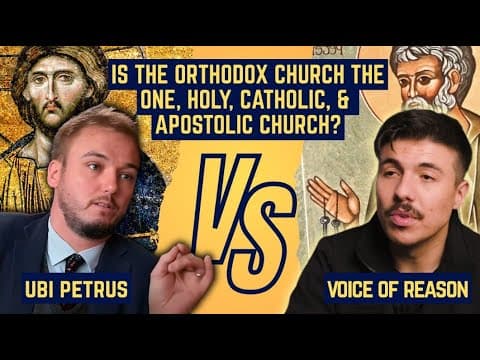
This blog post summarizes a debate on whether the Orthodox Church qualifies as the One, Holy, Catholic, and Apostolic Church, featuring arguments from both sides regarding historical context, ecclesiology, and the implications of schisms and councils.
In a recent debate held at the Ital Greek parish, the question posed was whether the Orthodox Church is indeed the One, Holy, Catholic, and Apostolic Church. The debate featured two prominent speakers: Ubie Petrus, defending the claim that the Orthodox Church fulfills this definition, and Alex, known as Voice of Reason, arguing against it. This blog post aims to summarize the key points made during the debate, providing insights into both perspectives.
The debate was structured into several segments:
Ubie began by emphasizing the historical continuity of the Orthodox Church, arguing that it maintains the same structure and beliefs as the early Church. He cited several historical examples:
Ubie argued that the Orthodox Church is Catholic in the sense that it encompasses all local churches and maintains the same faith, despite internal disagreements. He emphasized that the essence of the Church is found in its apostolic succession and the validity of its sacraments.
Alex countered Ubie's claims by asserting that the lack of a unified governance structure in the Orthodox Church undermines its claim to be the One, Holy, Catholic, and Apostolic Church. He made several key points:
Both speakers discussed the importance of ecumenical councils in defining orthodoxy. Ubie argued that the Orthodox Church has had councils that are binding, such as the Council of Jerusalem (1672), while Alex maintained that the lack of recognition from the papacy diminishes their authority.
The debate concluded with both speakers presenting their closing statements, reiterating their positions. Ubie emphasized the historical continuity and validity of the Orthodox Church, while Alex underscored the necessity of a unified governance structure under the papacy for the Church to fulfill its claim of being the One, Holy, Catholic, and Apostolic Church.
This debate highlighted the complexities surrounding the identity of the Orthodox Church and its relationship with the Catholic Church. As both sides presented compelling arguments, the question remains open for further exploration and dialogue among Christians seeking to understand the nature of the Church and its mission in the world today.



















