
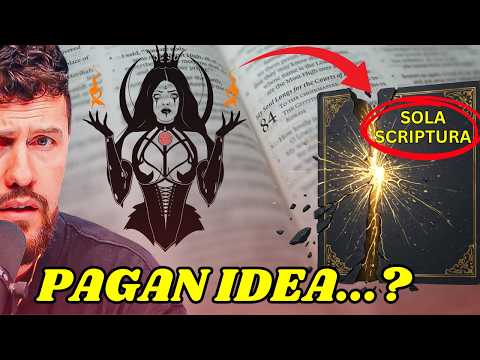
The Protestant doctrine of sola scriptura, which asserts that scripture alone is the authority for Christian faith, did not originate from the apostles or Jesus but has roots in ancient pagan philosophies like Stoicism and Gnosticism. Early Christians relied on apostolic tradition and the church's living authority. The split between scripture and tradition led to thousands of denominations and confusion. Embracing scripture, tradition, and the magisterium together preserves the fullness of the
The doctrine of sola scriptura, meaning "scripture alone," is one of the most celebrated principles of the Protestant Reformation. It asserts that the Bible is the only authority for Christian faith and life. However, this doctrine did not originate from Jesus or the apostles. Surprisingly, it shares more in common with ancient pagan philosophies such as Stoicism, Gnosticism, and Platonism than with the early Christian church.
Imagine being a Christian around the year 150 AD. The New Testament as we know it did not yet exist. The Gospels were still being hand-copied and circulated across the Roman Empire without chapters or verses. How did early Christians know what to believe?
They followed the living voice of the apostles and their successors, the bishops. St. Irenaeus, writing around 180 AD during his battle with the Gnostics, explained that the true gospel could be known by those whose local bishop could trace his ordination directly back to the apostles. This was not merely about texts but about living communion within the church as a body that received and guarded the faith together.
This concept was known as holy tradition—not man-made rituals or customs, but the living memory of the church. It encompassed how the church worshiped, interpreted scripture, and passed on Christ's teachings.
Fast forward 1,500 years to a Europe in upheaval. Corruption had crept into the church with indulgence sellers, political bishops, and scandalous clergy. Martin Luther emerged as a reformer who initially believed in the authority of the church and appealed to church councils and the church fathers.
However, during the Leipzig Debate in 1519, Luther was confronted with the fact that his views contradicted earlier councils. He famously declared, "Even if a thousand Augustines stood against me, I would still stand on scripture." This marked the beginning of a dangerous principle: that each individual could interpret the Bible independently of the church.
While Luther himself still believed in some form of tradition, his followers, especially the radical reformers like the Zwickau prophets and the Anabaptists, rejected the church, creeds, bishops, and councils entirely. They claimed to rely solely on the Holy Spirit and their personal reading of the Bible. Some even claimed that the Bible was unnecessary because God spoke directly to them.
This radical individualism was chaotic and alarming even to Luther, who said these radicals "swallowed the Holy Spirit, feathers and all."
The extreme individualism of sola scriptura did not come from the Bible but from pagan philosophies. The Stoics, Greek philosophers, believed in an inner divine reason or logos within every person, teaching that truth comes from within rather than being passed down. Similarly, the Gnostics believed in secret inner knowledge (gnosis) as the path to salvation, dismissing scripture and community.
When sola scriptura is taken to its extreme, it resembles these ancient errors: rejecting the church's authority and relying solely on personal revelation.
The Bible does say in 2 Timothy 3:16 that "All scripture is inspired by God and is useful for teaching, for reproof, for correction, and for training in righteousness." However, it does not say that scripture alone is authoritative or sufficient by itself.
Paul wrote to Timothy, a bishop trained in apostolic tradition, urging him to continue in what he had learned both by word and by writing. In 2 Thessalonians 2:15, Paul commands, "Hold fast to the traditions you were taught, whether by word of mouth or by letter."
Early Christians did not pit scripture against tradition but saw them as complementary, both flowing from one divine source. St. Basil the Great wrote that some teachings and practices come from written texts, others from the apostles by word of mouth, both having equal authority. St. Augustine famously said he would not believe the gospel unless the authority of the Catholic Church moved him to do so.
The church gave us the Bible. It was the bishops meeting in councils such as Hippo (393 AD) and Carthage (397 AD) who discerned which books were inspired and which were not. These councils also affirmed key doctrines like the Trinity, the Virgin Birth, and the Real Presence in the Eucharist.
Therefore, trusting the Bible inherently involves trusting the authority of tradition.
The Catechism of the Catholic Church teaches that sacred tradition and sacred scripture together make up a single sacred deposit of the word of God. Scripture must be read within the living tradition of the whole church. Without tradition, interpreting the Bible becomes like a compass without true north, leading to divergent beliefs such as denying the Trinity or the divinity of Christ.
In the 1600s, the Puritans sought to remove all elements they considered too Catholic, including Christmas, because it was not explicitly commanded in scripture. This created a vacuum later filled by secular historians who claimed Christmas was a pagan holiday stolen from Saturnalia.
However, early church fathers like Hippolytus and John Chrysostom provided theological explanations for celebrating Christ's birth on December 25th long before the Roman Empire was Christianized. Without tradition, such truths are forgotten and replaced by myths.
The fullness of the Christian faith rests on a three-legged stool: scripture, tradition, and the magisterium (the church's teaching authority). Scripture is the word of God; tradition is how the word has been faithfully lived and passed on; and the magisterium guards both from error.
This was affirmed at the Council of Trent in the 16th century, which stated that truths and rules of conduct are contained in both written books and unwritten traditions received from the apostles.
A young man once struggled to understand God's word. Despite reading the Bible daily, he became more confused. When he shared his struggles with an old Catholic priest, the priest explained, "God never meant for us to read the Bible alone. He gave us the church to read it with."
We are not spiritual orphans but belong to a family—the church Christ built—that has preserved scripture through centuries of persecution and heresies.
The shock is not only that sola scriptura has pagan echoes but how far we have drifted from the church that gave us the Bible. Yet, it is never too late to come home.
As St. Paul urges in 2 Thessalonians 2:15, "Stand firm and hold fast to the traditions you were taught, whether by word of mouth or by letter." Not scripture alone, but scripture with the church. Not private opinion, but apostolic truth. Not pagan whispers, but the living voice of Christ's bride, the Catholic Church.
Welcome home.



















